
In industrial poultry medicine, designing a flawless theoretical vaccination schedule is only half the battle. The remaining half depends entirely on the precision of the application technique. Delivering the exact dose to the correct target tissue without compromising vaccine virus viability across a massive breeder flock or embryonated egg line is the only definitive pathway to securing high antibody titers and homogeneous flock immunity (CV% < 20).
This article evaluates the primary vaccination pathways implemented in breeder complexes and hatcheries, auditing their advantages, disadvantages, antibody titer dynamics, and operational mechanics.
1. The Pinnacle of Hatchery Automation: In Ovo (In-Egg) Vaccination Mechanism
The most flawless intersection of industrial avian medicine and bioprocess engineering is In Ovo (In-Egg) Vaccination technology. While traditional hatchery methods vaccinate chicks post-hatch via coarse spray or subcutaneous injection, in ovo technology delivers the vaccine directly into the egg via robotic systems during the 18th day of incubation (during transfer), before the chick hatches.
- Target Vaccines: Predominantly Marek’s Disease, Infectious Bursal Disease (IBD/Gumboro), Newcastle Disease (ND), and Fowl Pox.
- Incubation Phase: Between 17.5 and 19.25 days of incubation (precisely during the transfer phase from setter to hatcher trolleys).
Advantages & Titer Kinetics:
- Early and Flawless Onset of Immunity: Before the chick ever encounters external environmental pathogens, its immune system is stimulated within the sterile micro-climate of the eggshell. The chick is born into the world with near 100% immediate protection.
- Mathematical Dosage Precision: In this hands-free automation layout, every single egg is injected with a micro-liter-precise dose. The classic live vaccine pitfall of “under or over-dosing” is completely engineered out of the system. Titer uniformity (CV%) across the flock population is virtually perfect.
- Operational Velocity and Zero Chick Stress: Capable of processing 40,000 to 60,000 eggs per hour, these smart systems slash hatchery labor overheads dramatically. Crucially, it bypasses post-hatch handling or spray stress, reducing the risk of early-life dehydration.
Disadvantages & Operational Hurdles:
- High Initial Capital Expenditure (CAPEX): Due to advanced optical sensor configurations and robotic architectures, in ovo machinery represents the highest initial investment and maintenance cost in hatchery equipment.
- Strict Sanitization and Cross-Contamination Constraints: The robotic needles must automatically sanitize themselves within fractions of a second between every single injection loop. A failure in the automation’s sanitation loop carries a high probability of cross-contaminating pathogens (e.g., Aspergillus fumigatus or Pseudomonas) from a compromised egg into thousands of healthy ones. Furthermore, the system must utilize advanced optical sensing arrays to identify and clear infertile or dead eggs; otherwise, exploding non-live eggs will contaminate the injection needles and compromise the production line.
2. Intramuscular / Subcutaneous Injection
- Target Vaccines: Inactivated (killed oil-adjuvanted) combination vaccines (ND+IB+EDS+IBD) and specific inactivated Salmonella regimes.
- Flock Rearing Phase: Late rearing period, executed during pre-photostimulation transfer phases (typically weeks 12 and 18–20).
Advantages & Titer Kinetics:
- Peak and Flawless Titer Stability: Every single bird receives an exact dose (e.g., 0.5 ml) directly into the breast muscle (IM) or under the skin of the neck (SC). There is zero risk of a bird skipping vaccination. This pathway yields the highest antibody titers and the lowest coefficient of variation (CV%) across the flock population.
- Prolonged Immunological Shield: The mineral oil adjuvant induces a slow, continuous antigen release, safeguarding the hen stably throughout the production lifecycle.
Disadvantages & Operational Hurdles:
- Maximum Labor and Stress Overhead: Requires individual handling of every bird. It is highly labor-intensive and introduces severe mechanical stress (handling stress) onto the flock.
- Mechanical Error Risks: Miscalibrated automatic syringes or incorrect needle angles can trigger muscle tissue necrosis, under-dosing, or focal abscesses if strict sanitation isn’t enforced.
3. Eye Drop Application (Ocular / Intraocular)
- Target Vaccines: Live ILT (Infectious Laryngotracheitis), ND, and IB variants.
- Flock Rearing Phase: Critical variant transition phases during rear or intermediate supports.
Advantages & Titer Kinetics:
- Apex Live Vaccine Titer Uniformity: Administering an exact drop into the conjunctiva utilizes the blinking reflex to channel the virus into the lacrimal duct and Harder’s gland. This method delivers the highest titer uniformity (low CV%) among all live field application pathways, completely bypassing droplet size risks or water quality variables.
Disadvantages & Operational Hurdles:
- Extreme Labor Barrier: Catching and holding every individual bird to verify drop absorption is operationally exhaustive. Due to logistical constraints, it is reserved strictly for high-stakes variant challenges in industrial scales.
4. Coarse Spray Vaccination
- Target Vaccines: Live Newcastle Disease (ND) and Infectious Bronchitis (IB) booster surf rounds, alongside Coccidiosis vaccines.
- Flock Phase: Day 0 (Hatchery) and routine top-up rounds during production.
Advantages & Titer Kinetics:
- Peak Mucosal/Local Immunity: Maintaining a large droplet diameter (>100 microns) focuses the vaccine directly onto the mucosal tissues of the eyes, nares, and upper respiratory tract, stimulating the Harder’s gland. It is the premier field method for triggering local IgA defenses.
- Operational Ease: Birds do not require catching. By managing climate controls and stopping indoor ventilation drafts, crews can rapidly blanket the flock using knapsack or automated sprayers, generating minimal stress.
Disadvantages & Operational Hurdles:
- Mechanical Precision Constraints: Droplet morphology is paramount. If the droplet size drifts below 50 microns (fine spray/aerosol), the live virus bypasses upper respiratory filtration and penetrates deep into lungs and air sacs. This triggers severe post-vaccination respiratory shocks and invites secondary E. coli complications.
5. Wing-Web / Wing-Stab Application
- Target Vaccines: Live Fowl Pox and Avian Encephalomyelitis (AE) vaccines.
- Flock Rearing Phase: Mid-rearing period (typically weeks 8–10).
Advantages & Titer Kinetics:
- High Specific Local Immunity: Applied by dipping a two-pronged slotted needle into the vaccine and piercing the wing web membrane (patagium). It strongly stimulates local tissue and systemic responses. 7–10 days post-application, the site can be audited for local “takes” (swelling/scabbing) to quantitatively verify successful immunogenicity.
Disadvantages & Operational Hurdles:
- High Complexity: Demands manual execution. Rapid, careless work can accidentally strike bone structures or blood vessels, causing permanent structural injuries. Shallow entry failure will result in complete vaccination failure.
6. Drinking Water Vaccination
- Target Vaccines: Live Gumboro (IBD), AE, ND, and IB booster regimes.
- Flock Phase: Implemented universally across rearing and lay cycles for mass flock coverage.
Advantages & Operational Ease:
- Lowest Labor Overhead: Achieved completely hands-free by routing the vaccine through the facility’s automatic water lines and medicator dosing loops, reducing operational expenses to a minimum.
Disadvantages & Titer Volatility (The Hidden Risks):
- Poorest Titer Uniformity (High CV% Probability): Bird water consumption patterns are highly unequal. Dominant birds over-consume vaccine volumes, while submissive birds miss access entirely, opening dangerous immunity gaps.
- Biofilm and Chemical Inactivation Mechanisms: Organic biofilm layers lining the interior walls of water pipes neutralize live vaccine viruses within seconds. Furthermore, chlorine sanitizers, heavy metal ions (Ca, Mg), and lime scaling alter protein structures. Skim milk powder or customized blue vaccine stabilizers must be added to neutralize water loops before introducing antigens.
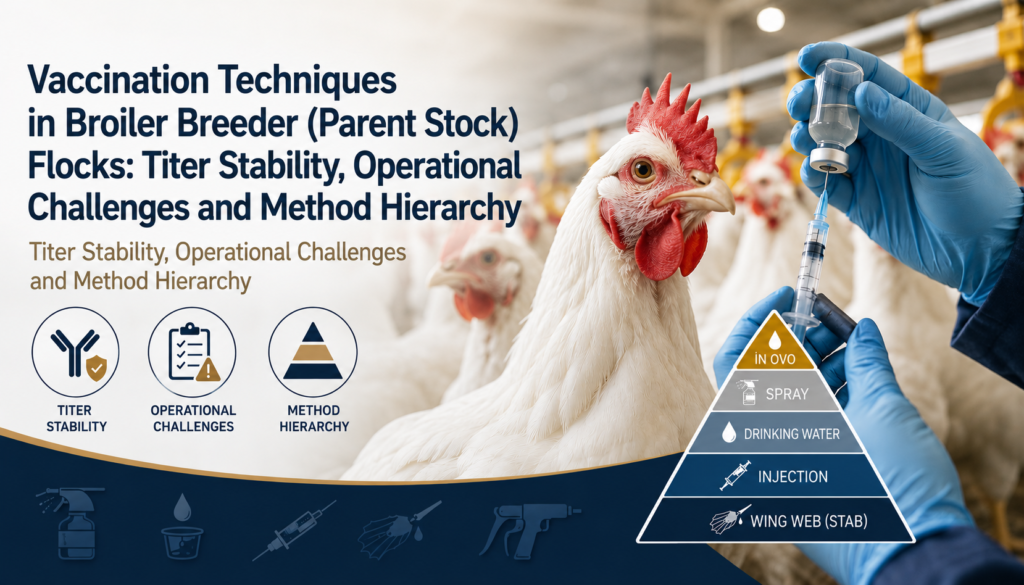
Application Pathway Hierarchy Based on Titer Stability and Uniformity
(Ranked From Best to Poorest / Highest Stability to Highest Risk Variance)
- In Ovo Vaccination (Automation Pinnacle): Undisputed leader for live vaccines due to embryonated-stage precise dosing and near-zero population variance (CV%).
- Injection (IM / SC): The leader in inactivated (killed) vaccine individual dosing stability (CV% minimized).
- Eye Drop: Offers flawless individual assurance for live vaccines, delivering top-tier titer stability.
- Coarse Spray: Exceptional at triggering local mucosal protection (IgA) when correct droplet metrics are maintained.
- Wing-Web: Highly reliable for localized tissue responses, though structurally confined to specific antigens (Pox/AE).
- Drinking Water: The weakest link; carries the highest risk of population titer variance (CV%), governed completely by water pipe sanitation and automation management.
💡 Field Engineering & Clinical Insights
- Water Vaccination Automation (The Thirst Derivation): Before flushing vaccine lines, check the house climate controller. Water lines must be isolated for 1–1.5 hours in summer or 2–2.5 hours in winter. The objective is to drive simultaneous access to the nipple lines the moment the vaccine arrives, ensuring the live virus is entirely consumed within 2 hours before viability decays in the pipes.
- Spray Ventilation Algorithms: Prior to initiating coarse spray, every exhaust fan must be cut via the PLC controller panel, and inlets locked down to eliminate internal drafts. Operating sprayers while ventilation lines are running simply flushes the suspended vaccine outside the house, vaporizing your financial investment. Restore climate loops systematically once spraying concludes.
References:
1. Giambrone, J. J., & Closser, J. (1989). Efficacy of spray vaccination against Newcastle disease and infectious bronchitis in broilers and breeders. Avian Diseases, 33(4), 778-782.

2. Bermudez, A. J., & Stewart-Brown, B. (2008). Disease Prevention and Control in Poultry Production. In: Diseases of Poultry, 12th Edition. Wiley-Blackwell.

3. Butcher, G. D., & Yegani, M. (2009). Investigating vaccination failures in poultry flocks. University of Florida IFAS Extension, VM136.