
In modern broiler breeder operations, hatching egg production is a sensitive bioprocess situated at the intersection of female parent stock (PS) reproductive physiology and environmental/nutritional management. The shell quality of eggs delivered to the hatchery is not merely a mechanical shield guarding the embryo; it is a vital biological parameter that directly governs hatchability, early embryonic mortality, and subsequent chick quality. Structural failures in eggshell architecture during the laying period trigger severe financial deficits across poultry integrations.
This article reviews the nutritional, pathological, and environmental root causes behind hairline cracks, misshapen geometry, and thin shell manifestations.
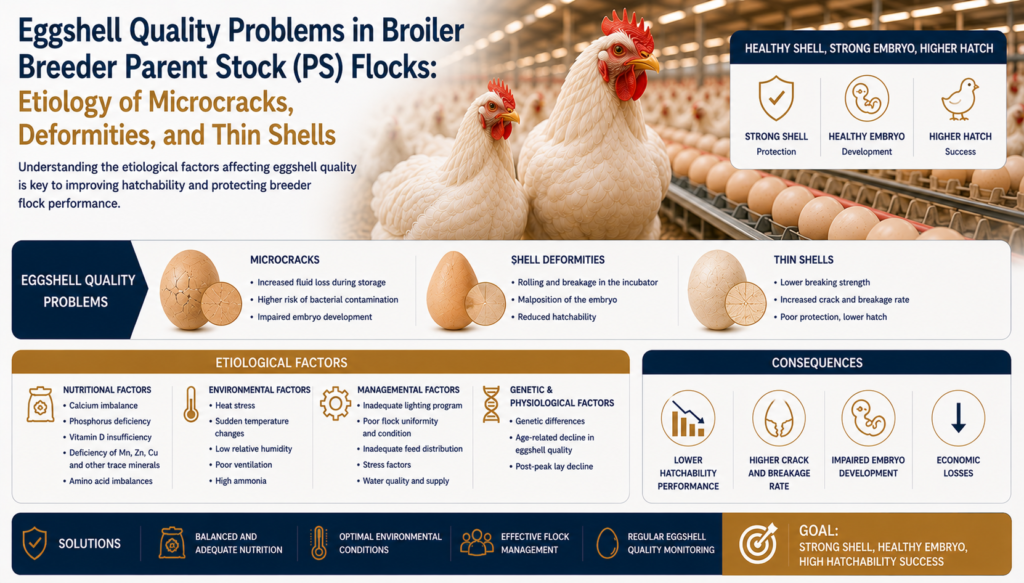
1. The Physiological Mechanism of Eggshell Calcification
The synthesis of an eggshell requires approximately 20 hours, with its most critical phase occurring within the uterus (shell gland) region of the oviduct. The shell matrix is predominantly composed of calcium carbonate (CaCO3) crystals (%95) embedded within an organic protein matrix. The hen derives the necessary calcium for this process from continuous dietary absorption and the mobilization of medullary bone reserves. Crucially, during the dark photoperiod (nighttime) when feed intake ceases, the uterus relies entirely on bone calcium mobilization. The slightest disruption in this homeostatic pathway results in immediate shell quality degradation.
2. Thin and Soft Shell Manifestations: Nutritional and Age-Related Factors
An increase in thin-shelled or shell-less eggs within a flock typically points to disruptions in calcium metabolism:
- Flock Senescence and Absorption Constraints: As the flock ages (specifically past week 45), the hen’s physiological capacity for intestinal calcium absorption and medullary bone mobilization decreases. Concurrently, egg size naturally increases with age, meaning the fixed amount of available calcium is distributed across a larger surface area, resulting in a thinner shell structure.
- Calcium, Phosphorus, and Vitamin D3 Equilibrium: Insufficient dietary calcium, as well as excessive available phosphorus , undermines shell integrity. Elevated blood phosphorus concentrations inhibit bone calcium mobilization. Furthermore, deficiencies in Vitamin D3, which is essential for the synthesis of intestinal calcium-binding proteins, or liver degradation caused by mycotoxins (specifically zearalenone and T-2 toxin) preventing conversion into its active metabolite 1,25 – (OH)2 – D3, directly trigger thin shell outbreaks.
- Heat Stress and Respiratory Alkalosis: When ambient house temperatures exceed 27oC, breeders initiate panting to facilitate evaporative cooling. This rapid respiration flushes carbon dioxide (CO2) from the blood, causing respiratory alkalosis. The resulting elevation in blood pH impairs the availability of carbonate ions in the shell gland, preventing them from binding with calcium ions. Consequently, thin shells manifest even if dietary calcium specifications are optimal.
3. Misshapen, Ridged, and Rough-Textured Shells: Pathological and Stress-Induced Etiology
Irregularities in external egg morphology indicate either compromised mechanical integrity of the oviduct or acute physiological stress:
- Oviduct Pathologies (Infectious Bronchitis – IB): Variant Infectious Bronchitis strains can cause permanent damage to the oviduct during the rearing phase and directly target the uterine epithelial cells during production. The resulting inflammation (salpingitis) prevents uniform deposition of the shell matrix, causing an influx of misshapen, flat-sided, corrugated, or ridged eggs on the setter trays.
- Environmental Stress and Delayed Ovaposition: Sudden ambient noises, mechanical vibrations from malfunctioning ventilation fans, or aggressive male treading release high concentrations of adrenaline in females. This physiological stress prompts the hen to retain the egg within the shell gland beyond normal timelines (delayed ovaposition). This extended retention results in erratic calcium deposition, manifesting as rough sandpaper textures, white plaques, or heavy chalky laminations on the shell surface.
4. Hairline Cracks: Mechanical and Structural Root Causes
Hairline cracks, a premier hazard for hatchery efficiency, occur due to a decrease in the shell’s elasticity modulus combined with mechanical impacts during automated handling:
- Conveyor Track Speed and Acceleration Calibration: The inrush currents and velocity transitions of egg collection conveyors leading from automatic nests to the packing station must remain damp and smooth. Sudden accelerations or bottlenecks at transfer junctions cause eggs to collide, fracturing shells with weakened structural integrity.
- Electrolyte Balance and Shell Elasticity: The dietary electrolyte balance directly influences shell resilience. Specifically, elevated chlorine levels in drinking water impair the calcium-binding mechanisms within the uterine mucosa, rendering the shell highly fragile against physical impacts.
Summary and Field Action Plan
Preserving eggshell quality is a holistic management discipline ranging from adjusting calcium-to-phosphorus ratios in accordance with flock senescence to managing house ventilation inputs to prevent respiratory alkalosis. When shell defects elevate, technical managers must avoid reactive choices. Instead, hatchery breakage data, weekly body weight uniformity, and serological antibody titers (IB/ND) must be analyzed in parallel to execute a precise, root-cause intervention.
References:
- Aviagen (2021). Ross 308 Parent Stock Management Handbook. Aviagen Technical Documentation.
- Nys, Y., & Guyot, N. (2011). Egg shell formation and quality. In: Improving the Safety and Quality of Eggs and Egg Products. Woodhead Publishing.
- Roberts, J. R. (2004). Factors affecting egg internal and external quality. World’s Poultry Science Journal, 60(1), 91-111.