
In broiler breeder parent stock (PS) operations, the initial hours of chick placement and the subsequent first 7 days exert a permanent influence over the flock’s future reproductive performance, uniformity, and livability metrics. During this neonatal phase, the chicks’ thermoregulatory mechanism is anatomically immature, leaving them entirely dependent on automated environmental control systems. A single thermal or nutritional error committed during this initial brooding window triggers poor organ development, compromised immune architecture, and irreversible uniformity losses across the flock lifecycle.
This article reviews the operational protocols, thermodynamic limits, and critical clinical checkpoints of the chick brooding phase in breeder operations.
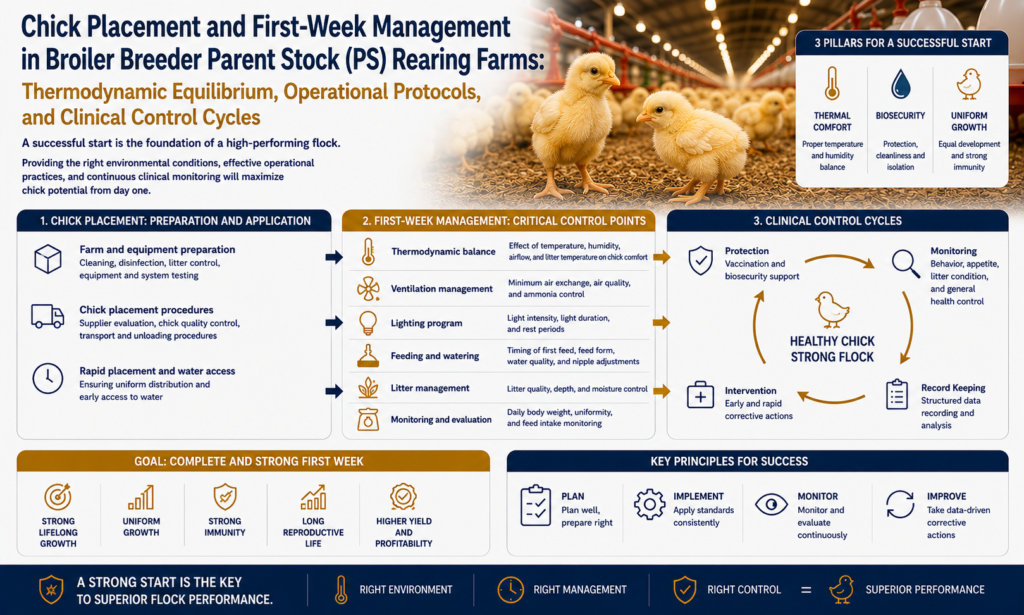
1. Pre-Placement Protocols: Pre-Heating and Equipment Calibration
From a biosecurity standpoint, the rearing facility must have completed a minimum 21–28 day downtime. Prior to placement, all mechanical infrastructure must be rigorously prepared:
- Comprehensive Pre-Heating: House heating systems must be activated at least 48 hours prior to chick arrival. The objective is to stabilize the litter and concrete floor temperature, not just the ambient air. Upon placement, litter temperature must be a minimum of 32 oC , with an ambient air temperature of 33 – 34 oC. Cold litter induces thermal heat loss through the chicks’ legs (hypotermis), halting gizzard functions and yolk sac absorption (vitellus retention issues).
- Water and Feed Line Configuration: Stagnant water within the nipple lines must be completely flushed, stabilizing the water temperature between 18 and 21 oC. Alongside automated lines, clean brooding paper must cover at least %80 of the floor space, pre-loaded with 40 grams of fresh, sieved crumb feed per chick.
2. The Thermodynamic Limit: Temperature and Relative Humidity (RH%) Equilibrium
In avian physiology, the perceived temperature felt by the chick is a direct mathematical function of ambient relative humidity (RH%). Dry air accelerates evaporative cooling, chilling the chick; excessive humidity halts heat dissipation, inducing thermal shock.
- The Psychrometric Matrix: The optimal relative humidity boundary sits between %60 and %75. If the ambient RH% falls below %60, the house target temperature must be elevated by 0.5 oC for every %10 drop in humidity.
- Clinical Air Velocity Limits: Heater sensor calibrations must be audited periodically. Air velocity at chick level must never exceed 0.15 m/s. High velocity creates a wind-chill effect, dropping internal body temperatures.
3. Chronological Clinical Audit Checkpoints
The moment chicks are released into the brooding zone, the technical team’s operational timeline must adhere to a strict chronological protocol:
Hour 2: Behavioral Distribution Audit
- Assessment: Monitor chick dispersion patterns across the floor. If chicks huddle directly underneath heaters, the house profile is cold. If they flee to the walls in silence, hyperthermia is occurring. Ideally, chicks should display homogeneous dispersion, actively vocalizing, feeding, and drinking.
Hour 8: Crop Fill Phase 1 Evaluation
- Assessment: Randomly sample at least 100 chicks across various house zones to palpate crops. The crop must feel pliable, filled uniformly with feed and water. At hour 8, the target crop fill metric must be a minimum of %80. Hard, feed-only crops indicate restricted water access; empty crops signify complete failure to locate resources.
Hour 24: Crop Fill Phase 2 and Internal Temperature Audit
- Assessment: At hour 24, the crop fill metric must reach at least %95. Concurrently, random cloacal (rectal) temperatures must be logged using digital pediatric thermometers. The ideal core temperature must stabilize between 40.0 and 40.6 oC. Measurements below 39.5 oC indicate hypothermia, while those above 41.0 oC indicate dangerous hyperthermia.
Day 3: Lighting and Ventilation Transitions
- Assessment: Evaluate feed clearance velocity and fecal consistency. Monitor litter moisture variations to protect intestinal integrity. Optimize air inlets to prevent stagnant dead zones.
Day 7: Comprehensive Weight and Uniformity Audit
- Assessment: Conduct flock weighing. The day 7 body weight must reach a minimum of 4 to 4.5 times the initial day-old hatch weight. If the population coefficient of variation (CV%) remains below %8, the brooding phase is graded successful.
4. Lighting, Ventilation, and Nutritional Management
Minimum Ventilation Architecture:
During week 1, ventilation serves exclusively to exhaust carbon dioxide (CO2 < 2500 ppm), ammonia (NH3 < 10 ppm), and structural moisture without chilling the flock. The automated ventilation configuration must operate strictly in a time-cycle dependent Minimum Ventilation mode. Incoming cold air via the inlets must be driven along the ceiling profile to heat up and mix thoroughly before descending into the chick zone, requiring flawless static pressure calibration.
Photoperiod Profiles:
During the initial 24–48 hours, a profile of 23 hours of light (at a minimum intensity of 60–80 lux) and 1 hour of darkness is enforced to maximize feed and water discovery. Starting on day 3, the dark period is gradually expanded to facilitate melatonin synthesis and skeletal modeling, while intensity is dropped to 10–20 lux to regulate early growth rates.
Feed and Water Dynamics:
Nipple heights must initially lock at chick eye level; the chick should angle its head slightly upward to actuate the pin. Line pressure must be set low to allow effortless pin actuation. As paper-fed crumb volumes deplete, transitions to automated pan or chain tracks must be managed gradually to prevent automated feeder avoidance.
5. Contingency and Field Intervention Matrix
| Observed Field Phenomenon | Probable Root Cause | Field Corrective Action |
| Chicks huddling along walls, displaying lethargy | Excessive ambient heat or high relative humidity. | Reduce heater staging outputs; expand minimum ventilation runtime cycles to exhaust moisture. |
| Chicks clustering tightly in groups, high-pitched vocalization | Low litter temperature or localized air drafts (wind-chill). | Audit floor temperatures; realign air inlet (klape) trajectories toward the ceiling; elevate static pressure. |
| Hour 8 crop fill metric scores below %60 | Insufficient light intensity, elevated water temperatures in lines, or restricted feeder surface area. | Elevate lux outputs; flush water lines to clear warm water loops; expand paper brooding layouts. |
| Premature litter slickness or moisture accumulation | High automated line water pressure, or early enteritis outbreaks. | Regulate line pressure downward; optimize relative humidity levels; expand ventilation runtime constants. |
References:
- Aviagen (2021). Ross 308 Parent Stock Management Handbook. Aviagen Technical Documentation.
- Cobb-Vantress (2022). Broiler Breeder Management Guide. Cobb Operational Manual.
- Bell, D. D., & Weaver, W. D. (2002). Commercial Chicken Meat and Egg Production (5th Edition). Springer Science & Business Media.