
In industrial poultry production—spanning Parent Stock (PS) breeder operations and commercial broiler grow-out cycles—translating genetic potential into peak field performance depends directly on microclimate and mechanical automation engineering, alongside optimal hatching egg and meat yield targets. The physiological requirements of global genetic lines, such as Ross (Ross 308/708), Cobb (Cobb 500/700), Hubbard (Efficiency Plus/Hi-Y), and Arbor Acres (AA Plus), exhibit radical variations across flock phases (PS Rearing, PS Production, and Broiler grow-out).
This comprehensive technical guide evaluates the engineering criteria for selecting Ventilation, Feed Storage (Silos), Feed Weighing and Transport, Feeder, Drinker, Nesting, and Lighting systems, structured by genetic line and flock stage.
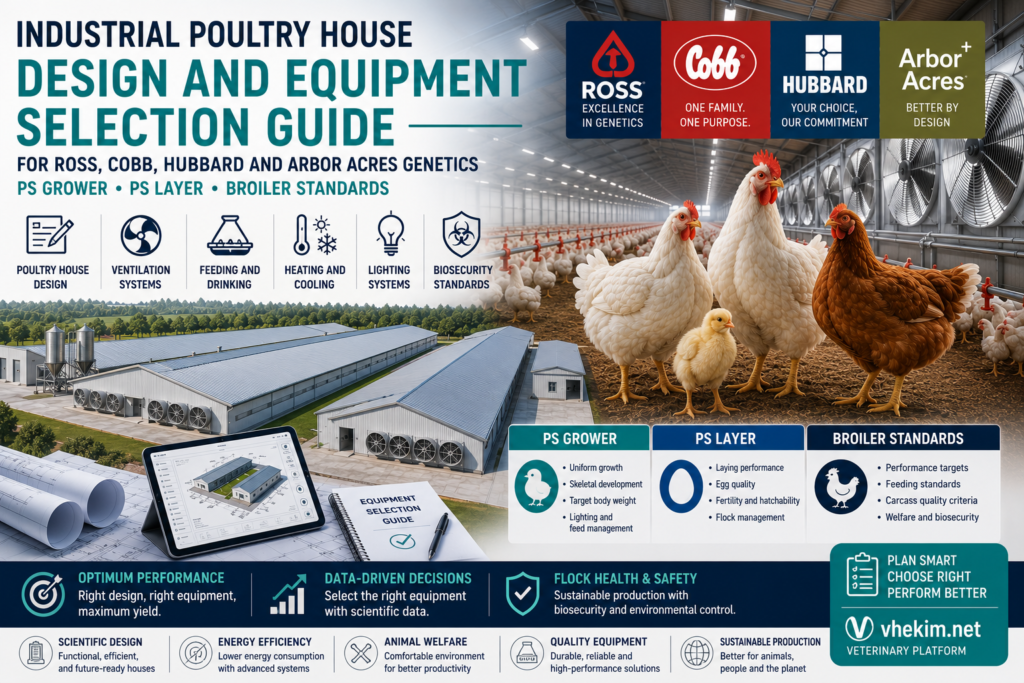
1. Equipment and Spatial Standards by Flock Phase and Genetics
Before selecting mechanical equipment, baseline spatial allowances, stocking densities, and equipment allocations must be defined for each genetic line and production model:
A. Parent Stock Rearing Phase (PS Pullet: 0–18 Weeks)
The primary objective in breeder rearing is to control skeletal development and achieve high flock uniformity (%85+) under quantitative feed restriction protocols.
- Stocking Density: Ideal stocking density for Ross and Cobb PS rearing ranges from 6.5 to 7.5 birds/m². For Hubbard and Arbor Acres pullets, targets are set at 7.0 to 8.0 birds/m².
- Feeder Space Allocation: Under feed restriction, all birds must access feed simultaneously. Circular chain feeding systems require 14 to 16 cm/bird, while pan feeding systems require 10 to 12 birds/pan.
- Drinker Allocation: Nipple drinkers with drip cups require 8 to 10 birds/nipple, while bell drinkers require 80 to 100 birds/bell.
B. Parent Stock Production Phase (PS Breeding: 18–64 Weeks)
During the production phase, management shifts toward hatching egg hygiene, fertility rates, male-female feeding separation, and the absolute prevention of floor eggs.
- Stocking Density: Ross 308 and Cobb 500 PS production assets target 5.0 to 5.5 hens/m² (totaling ~5.5–6.0 birds/m² including males). Slatted flooring must cover 40% to 50% of the total house area.
- Sex-Separate Feeding: Female feeders must incorporate male exclusion grills or wire gaps (43 to 45 mm grill spacing). Dedicated male feeding lines providing 18 to 20 cm/male should be installed along side walls.
- Drinker Allocation: Nipple lines positioned over slatted areas should be adjusted to 6 to 8 hens/nipple.
C. Commercial Broiler Grow-Out Operations (0–35/42 Days)
In broiler grow-out, the primary target is maximizing Average Daily Gain (ADG) and optimizing Feed Conversion Ratio (FCR).
- Stocking Density: Depending on climate control capacity, target live weight density ranges between 33 and 39 kg/m², corresponding to approximately 14 to 18 birds/m².
- Feeder and Drinker Allocation: Pan feeders require 45 to 55 birds/pan; high-flow nipple lines (90–100 ml/min) require 10 to 12 birds/nipple.
2. Ventilation and Climate Control Equipment Selection
Ventilation functions as a critical bioprocess mechanism that manages moisture, ammonia (NH3), carbon dioxide (CO2), and oxygen (O2) balances beyond simple temperature regulation.
A. Minimum and Transitional Ventilation
- Equipment: Wall air inlets, baffle systems, and side-wall/roof exhaust chimney fans (~15,000 – 18,000 m3/h).
- Criteria: Minimum ventilation operates independently of ambient temperature, driven strictly by live weight metrics and gas/moisture removal demands. Inlets must utilize the Coanda effect, directing incoming cold air along the ceiling ridge to warm before falling onto the birds. Negative static pressure must be maintained between 15 and 20 Pa.
B. Tunnel Ventilation and Evaporative Cooling
- Equipment: Tunnel Cone Fans (46,000 – 52,000 m3/h) and Evaporative Cooling Pads (100 mm or 150 mm cellulosic pads).
- Wind Chill Effect:
- Broiler Operations: Target wind velocity inside tunnel mode must reach a minimum of 2.5 to 3.0 m/s.
- Ross / Cobb PS Production: Target wind velocity should be calibrated between 2.2 and 2.5 m/s. Excessive wind speeds disrupt hen behavior, driving stress during nesting.
- Cooling Pad Face Velocity: Air velocity passing through 150 mm thick pads must not exceed 1.5 m/s, while 100 mm pads require a maximum face velocity of 1.0 m/s.
💡 Technical Tool: To calculate the exact fan quantities, pad areas, and inlet requirements for your specific house dimensions and flock genetics, deploy our Industrial Poultry Equipment and Capacity Requirement Calculation Tool.
3. Feed Storage (Silos), Weighing, and Conveying Systems
Maintaining feed quality and executing precise daily feed allocations are vital, particularly in feed-restricted Parent Stock operations.
A. Feed Silos
- Capacity and Material: Galvanized steel or corrugated sheet silos are standard. Silo capacity should be sized to hold a minimum of 1.5 to 2 times the maximum daily house consumption (or 3–5 days of emergency reserve).
- Thermal Insulation and Ventilation: Silos must feature top inspection/ventilation caps to prevent internal moisture condensation and mycotoxin formation. In high-temperature regions, solar-reflective white coatings or double-walled insulated silos are recommended.
B. Feed Weighing and Transport Systems
- Parent Stock Batching Scales: Because daily feed allocations in breeder pullets and layers are administered in precise grams per bird (g/bird), feed transferred from silos into day-bins must pass through digital load-cell batching scales with an error margin below 0.5%.
- Feed Conveying Lines (Auger & Chain): High-capacity flexible augers (Ø 75 – 90\ mm$) convey feed from silos to internal hoppers. Auger speeds and helix angles must be engineered to prevent pellet breakage and dust generation (fines).
4. Feeder System Selection
A. Breeder Rearing and Production (PS) Feeders
- High-Speed Chain Feeders: The industry standard for PS rearing and production. High-speed drive units (minimum 30 to 36 m/min) distribute feed rapidly across the entire circuit. Slow chain speeds allow dominant birds to consume the ration at the hopper entry point, destroying flock uniformity.
- Sex-Separate Feeding Systems: Production houses require dedicated, height-adjustable male pan feeding circuits. Female feed troughs must be fitted with anti-male grills to restrict rooster access.
B. Commercial Broiler Feeders
- Pan Feeders: Provide continuous access from day-old brooding through harvest. W-shaped or conical pan bottoms minimize feed spillage. Automatic overflow settings should be engaged during brooding, then lowered as birds mature to control feed levels.
5. Drinker System Selection
Water governs feed consumption dynamics and metabolic heat dissipation.
- Nipple Drinker Systems: Closed nipple systems represent the industry standard for litter dryness and hygiene.
- Flow Rate and Pressure Calibration:
- Brooding / Week 1: 20 – 30 ml/min flow rate with drip cups.
- Broiler Grow-Out: 80 – 100 ml/min flow rate (high-pressure setup).
- Parent Stock (PS): Medium-pressure, counter-weighted nipple lines (50 – 70 ml/min) are used to control water intake and maintain dry litter conditions.
- Line Sanitation and Filtration: Every house intake must feature 5–20 micron sediment filters, water meters, and medicator dosing pumps (Dosatron).
6. Nesting System Selection (PS Production Houses Only)
In Parent Stock production facilities, nest design directly determines hatching egg hygiene, floor egg percentages, and hatchability.
- Automatic Roll-Away Nests: Eggs laid onto perforated synthetic turf mats automatically roll onto a central collection belt, isolating the egg from fecal contamination.
- Capacity Sizing: Automatic roll-away nests require a sizing standard of 100 to 120 hens per linear meter of nest space. Manual nest boxes require 4.5 to 5.0 hens per nest hole.
- Floor Egg Prevention Protocols: Slat slopes leading to nests should not exceed 8% to 10%. Nest interiors must remain dark and draft-free while maintaining adequate internal airflow. Automated expulsion systems (expeller bars) must gently push hens out of nests at night to prevent roosting and contamination.
7. Lighting Systems and Photoperiod Management
Lighting stimulates melatonin and gonadotropic hormones (FSH/LH), regulating muscle growth, sexual maturity, and oviposition cycles.
A. Luminaire and Spectrum Selection
- LED Technology: Dimmable (0–10V / DALI) LED fixtures rated at IP65/IP67 ingress protection, resistant to ammonia gas and high-pressure washing, are required.
- Spectral Wavelengths (Kelvin):
- Rearing and Broilers: Green/Blue spectral output (5000K – 6500K Cool White) promotes muscle development and calm flock behavior.
- Breeder Production: Red spectral output (2700K – 3000K Warm White) penetrates the skull to stimulate the hypothalamus, driving reproductive hormones and egg production.
B. Light Intensity and Photoperiods
- Broiler Grow-Out: Days 1–7 require 30 – 40 lux (23 hours light / 1 hour dark), stepping down to 10 – 20 lux with structured dark periods.
- Breeder Rearing (Darked Housing): To prevent premature sexual stimulation, light intensity is locked at 5 to 10 lux with a strict 8-hour photoperiod after week 1.
- Breeder Production (Photostimulation): At weeks 18–21, photoperiods are incrementally increased from 8 hours to 15–16 hours, while light intensity is elevated to 30 to 60 lux.
Summary and Engineering Check-List
Designing an industrial poultry facility requires a holistic approach rather than evaluating equipment in isolation. House geometry, genetic specifications (Ross, Cobb, Hubbard, Arbor Acres), and climate control capacities must be integrated seamlessly. From feed silos and lighting spectra to ventilation airflow rates and automatic nest sizing, every precise engineering decision defends FCR metrics, maximizes hatchability, and extends the commercial life of the enterprise.
References:
- Aviagen (2020). Ross 308 & Arbor Acres Parent Stock and Broiler Management Handbooks. Aviagen Technical Library.
- Cobb-Vantress (2021). Cobb 500 Broiler and Breeder Management Guides: Housing, Ventilation, and Equipment Standards.
- Hubbard Breeders (2022). Hubbard Efficiency Plus Breeder & Broiler Technical Guidelines.
- Czarick, M., & Fairchild, B. D. (2020). Poultry Environmental Management and Equipment Sizing Principles. University of Georgia Cooperative Extension.
Pingback: Industrial Poultry Equipment and Capacity Requirement Calculation Tool - vhekim.net