
Poultry medicine (Avian Medicine) is far more than examining an individual patient and writing a prescription; it is the science and art of managing an integrated “biological population” of tens of thousands of individuals, its microclimate, and a massive commercial enterprise. Compared to companion animal practice or large animal clinical work, it is a dynamic field where decisions are made within seconds, financial margins are tight, and the veterinarian must operate with a highly versatile, multidisciplinary mindset—acting much like a “Swiss Army knife” in the field.
What exactly awaits a veterinary surgeon stepping into the poultry sector or seeking deeper expertise in this discipline? Beyond the operational challenges, what kind of career trajectory, prestige, and professional future does this industry offer?
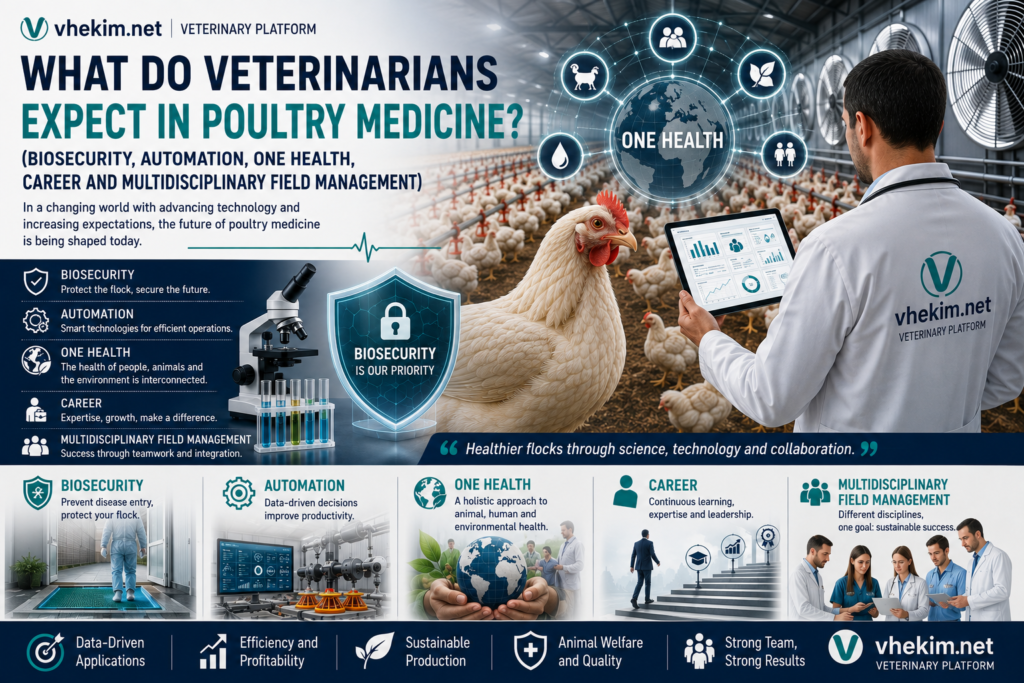
1. The Mindset Shift: From Individual Care to Population Health
In poultry medicine, the “patient” is not a single bird, but the flock in its entirety. The core mental paradigm shifts required of the veterinarian include:
- Marginal Gains and FCR Centricity: The cost of treating an individual bird often exceeds its economic value. Decision-making is governed strictly by industrial metrics: Feed Conversion Ratio (FCR), Average Daily Gain (ADG), livability rates, and carcass/egg quality.
- Statistical Precision in Necropsies: Performing a necropsy on a single bird when disease symptoms emerge in a house is misleading. The veterinarian must select a representative sample from the flock, conduct systematic necropsies, and generate a reliable macroscopic lesion score.
- The Absolute Supremacy of Preventive Medicine: Treating a disease after an outbreak in poultry is almost always an economic loss. The primary objective is not curing sick birds, but preventing pathogen entry through flock vaccination schedules, spray/water administration audits, serological monitoring (ELISA/PCR), and strict biosecurity protocols.
2. Micro-Level Mastery: From the Smallest Bolt to Complex Automation
When a field veterinarian takes off the lab coat and steps into coveralls, they must also wear the hats of a technician and an engineer. The veterinarian must master every detail of their assigned unit, from the smallest mechanical bolt to the most complex control panel.
- Electrical Panels and Automation Control: House climate controllers (Munters, Hotraco, Rotem, etc.), Variable Frequency Drive (VFD) faults, and sensor calibrations cannot be foreign to the veterinarian. A veterinarian who understands basic electrical systems can intervene immediately during automation lockups, saving thousands of birds from mortality caused by ventilation failure (suffocation).
- Field Mechanical Problem-Solving: If a feed transport auger snaps, a nipple line pressure regulator malfunctions, or a fan belt breaks, the veterinarian must diagnose the issue on the spot and execute mechanical troubleshooting.
- Poultry House Climate Engineering: An outbreak of E. coli or CRD is frequently non-infectious in origin, stemming instead from flawed minimum ventilation, insufficient static pressure (negative pressure), or wet litter. The veterinarian must independently calculate airflow demands, fan capacities, and inlet opening angles.
3. Immaculate Archiving: The Critical Role of Data and Document Tracking
In poultry medicine, “one can never predict which document, test report, or historical data point will prove vital in the future.” Beyond clinical duties, the veterinarian must operate as a disciplined archivist, maintaining meticulous records.
- Retrospective Data Traceability: Historical water analysis reports, vaccine batch/lot numbers, feed mycotoxin screenings, temperature/humidity logs, and necropsy scores must be systematically archived.
- Data-Driven Crisis Guidance: When troubleshooting a chronic, unexplained FCR drift or sudden immunosuppression, a months-old raw material change log or a water pH trend line may provide the single critical clue needed to resolve the issue. The veterinarian must flawlessly manage everything from regulatory compliance documents to internal audit files.
4. Team Leadership, Coordination, and High-Risk Real-Time Decisions
A poultry veterinarian is not only a medical doctor, but an operational leader capable of taking decisive action under extreme time pressure.
- Team Coordination and Human Management: Biosecurity protocols and vaccination schedules mean little on paper if not executed flawlessly in the field. Training, leading, and auditing farm technicians, caretakers, and vaccination crews fall directly under the veterinarian’s leadership.
- High-Risk Real-Time Decision-Making: During an automation blackout, power failure, generator fault, or suspected disease outbreak, there is no room for hesitation. The veterinarian must calmly and instantly execute high-risk decisions—such as emergency ventilation interventions, flock movement orders, or early depopulation—that impact thousands of lives and substantial financial assets.
5. Operating as a Portable Laboratory: Water and Feed Sensitivity
In demanding field environments, there is rarely time to wait days for laboratory results. The veterinarian must operate like a mobile diagnostic laboratory within the facility:
- Sensory and Diagnostic Acumen for Water and Feed: Fluctuations in drinking water pH and free chlorine, as well as microbiological and chemical risks, must be continuously tracked using portable field instruments (pH meters, ORP/Chlorine meters).
- Physical Feed Quality Analysis: By evaluating mycotoxin risks, Pellet Durability Index (PDI), dust ratios, or subtle changes in feed odor and color, the veterinarian proactively prevents enteric pathologies (enteritis) and subsequent FCR losses.
6. The “One Health” Imperative, Environmental Biosecurity, and Zoonosis Control
The poultry veterinarian serves as the first line of defense protecting not only the enterprise’s balance sheet, but also the surrounding environment, ecosystem, and Global Public Health.
- Adherence to “One Health” Principles: Human, animal, and environmental health are recognized as an interconnected whole. Managing manure disposal, wastewater treatment, and mortality disposal without ecological degradation is a core professional responsibility.
- Zero Tolerance for Zoonoses: Preventing zoonotic pathogens such as Salmonella spp., Campylobacter, Listeria, and Avian Influenza from spreading from farm to table—or into wild ecosystems—is a fundamental medical mission.
- Responsible Antimicrobial Stewardship: To combat global antimicrobial resistance, veterinarians must minimize antibiotic reliance by prioritizing preventive medicine, biosecurity, and gut health solutions (organic acids, probiotics, enzymes).
7. Beyond the Challenges: Career, Prestige, Advancement, and Global Networking
What is the ultimate return on investment for this heavy field workload, high responsibility, and continuous monitoring? Poultry medicine offers some of the fastest career advancement tracks and highest industrial prestige within the veterinary profession:
- Quantifiable Success and Rapid Promotion: Because performance is measured through concrete data (FCR, livability, hatchability), professional achievement is transparent and indisputable. A veterinarian who consistently lowers FCR, controls mortality, and leads teams effectively can rapidly advance from Field Veterinarian to Live Production Manager, Hatchery/Breeder Director, and Chief Operating Officer (COO).
- Global Networking and Professional Connections: The poultry industry is a tightly knit, highly interconnected global sector. Throughout their career, a poultry veterinarian collaborates directly with international experts from genetic companies (Aviagen, Cobb, Hubbard), global pharmaceutical and vaccine manufacturers, feed additive developers, and equipment leaders (Munters, Big Dutchman, etc.). This yields an extraordinary international professional network.
- Industry Prestige and Technical Authority: A poultry veterinarian who commands medicine, engineering automation, financial budgets, and crisis management is viewed not merely as an employee, but as a strategic technical authority managing multi-million-dollar assets and human resources. They frequently emerge as Key Opinion Leaders (KOLs) at international conferences and industry summits.
- Diverse Career Pathways: A seasoned field veterinarian is not restricted to farm management alone. Career progression can lead to positions such as:
- Technical / Regional Director at multinational pharmaceutical and vaccine corporations,
- Animal Nutritionist / Formulation Specialist at global feed and premix manufacturers,
- Global Technical Consultant for primary breeding genetics firms,
- Or establishing an independent Poultry Health and Climate Engineering Consultancy, generating substantial income and professional standing.
Summary and Conclusion
A veterinary surgeon entering poultry medicine should expect a role as a comprehensive system manager—utilizing screwdrivers, pH meters, archive files, and financial calculators alongside their stethoscope. This discipline blends medical science with automation, mechanical engineering, finance, crisis management, and One Health principles. For veterinarians who seek to work beyond individual clinical cases—managing large-scale biological systems, structured data, and human teams—the poultry sector delivers exceptional professional fulfillment, rapid advancement, global career pathways, and unmatched industry prestige.