
Managing indoor air quality and temperature in modern poultry production requires integrating the laws of static pressure and fluid acoustics with biological demands. Ventilation is not a static single-gear system; it is divided into 4 distinct phases that update dynamically based on flock age, biomass, and ambient weather conditions: Minimum, Transitional (Combined), Tunnel, and Natural Ventilation.
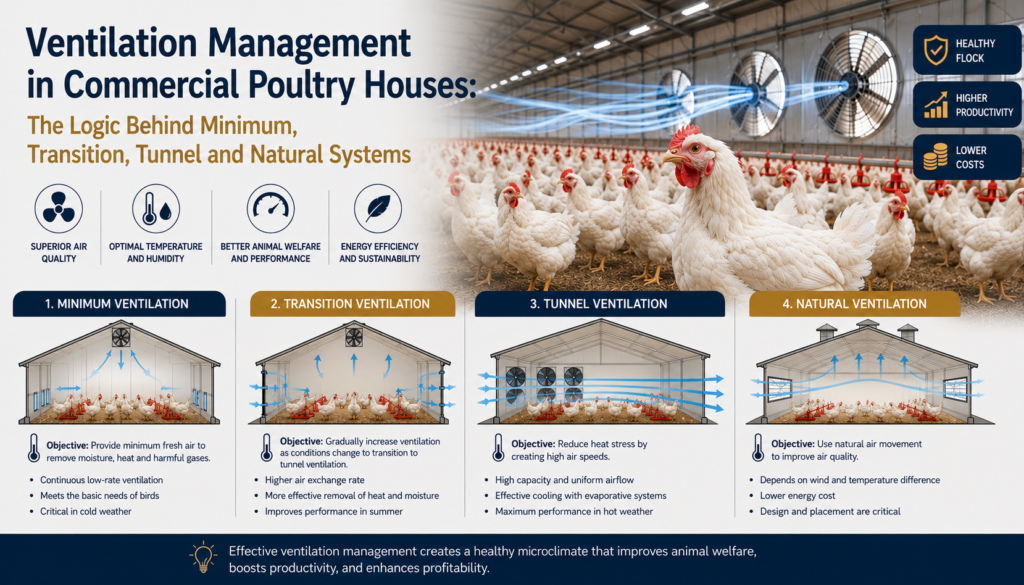
1. Minimum Ventilation
- Primary Objective: To provide oxygen (O2) and exhaust carbon dioxide (CO2), ammonia (NH3), and excess moisture without chilling the house.
- Operating Mechanism: Executed when the ambient outdoor temperature is below the house set point (primarily during the brooding phase and winter seasons). Side-wall inlets operate in tight synchronization with exhaust fans.
- Logic: Instead of running continuously, pre-defined or user-optimized timer cycles within the ventilation controller are deployed based on actual needs. Air enters the house through the inlets via high negative static pressure. It is then expelled out of the house by exhaust fans, also known as minimum ventilation fans. Keeping the air velocity at bird level near zero is a critical requirement.
💡 Technical Tool & Application: To automatically calculate the required minimum, transitional, and tunnel ventilation airflow capacities for your house based on live weight, flock age, and ambient conditions, visit our Automated Ventilation Airflow Calculation Tool for Industrial Poultry Houses.
Negative Pressure and Thermodynamic Moisture Cycle in Minimum Ventilation
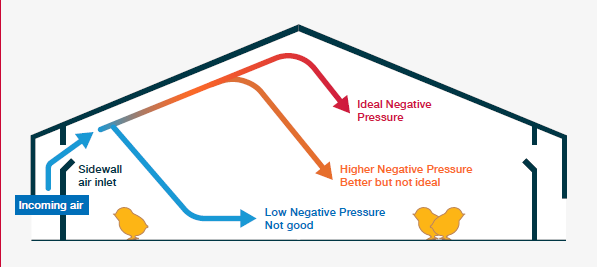
The heart of minimum ventilation operates via a negative pressure (vacuum) mechanism. As exhaust fans expel indoor air, the internal static pressure drops below the ambient atmospheric pressure. Due to this pressure differential, fresh, cold outdoor air is drawn through the active side-wall inlets as high-velocity jet streams. During this phase, the cooling pad doors/curtains remain sealed, and the tunnel ventilation fans are completely deactivated.
The thermodynamic journey of this mechanism operates step-by-step as follows:
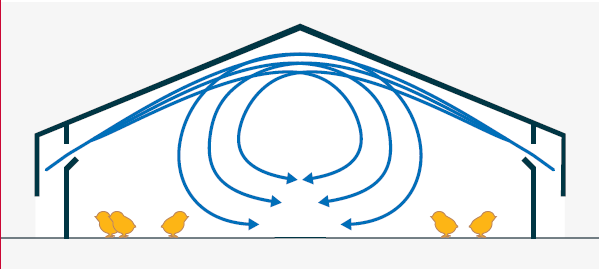
- Jetting Air to the Ceiling: Under a correctly calibrated negative pressure (20-30 Pa}), cold incoming air does not drop straight to the floor despite being heavier. Instead, it is thrown at high velocity toward the center of the house ceiling.
- Thermal Mixing at the Apex: The warmest air in the facility naturally rises and accumulates near the ceiling. The cold, fresh intake air meets this pocket of warm air, mixing thoroughly and absorbing its thermal energy.
- The Moisture Sponge Effect (Psychrometrics): As a fundamental physical rule, as air temperature increases, its moisture-holding capacity expands exponentially. As the fresh air warms at the ceiling, its relative humidity drops, turning it into a “dry molecular sponge.”
- Litter Evaporation and Exhaust: Having warmed and changed its specific weight, this dry air gently descends toward bird level (the floor). Upon reaching the floor, it absorbs excess moisture from the litter and captures volatile ammonia gas released from the manure. Finally, the suction power of the exhaust fans at the end of the line expels this saturated, contaminated air out of the facility.
CRITICAL WARNING: If the negative pressure is insufficient, the air fails to reach the ceiling and drops directly onto the chicks as cold drafts. This chills the birds and causes the litter to retain moisture, rendering the flock vulnerable to clinical outbreaks such as Coccidiosis and Enteritis.
2. Transitional Ventilation
- Primary Objective: To manage moderate ambient temperatures where minimum ventilation cannot remove enough heat, but tunnel ventilation would chill the birds via the wind-chill effect.
- Operating Mechanism: As the biomass grows and the outdoor temperature rises, the total heat load increases. Side inlets are opened to their safe maximum, and larger tunnel fans are activated incrementally.
- Logic: Air still enters through the side inlets but is drawn out by the tunnel fans. A longitudinal wind velocity at the bird level is not yet established; the sole metric here is increasing the volumetric air exchange rate. During this stage, the cooling pad doors/curtains remain closed, and only a few of the tunnel ventilation fans are operational.
3. Tunnel Ventilation
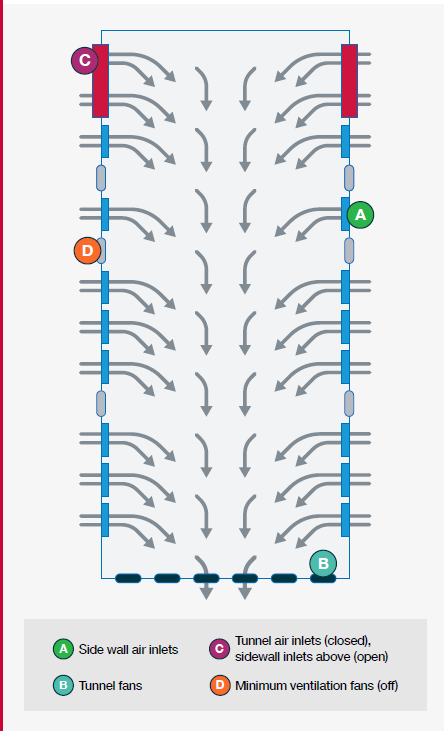
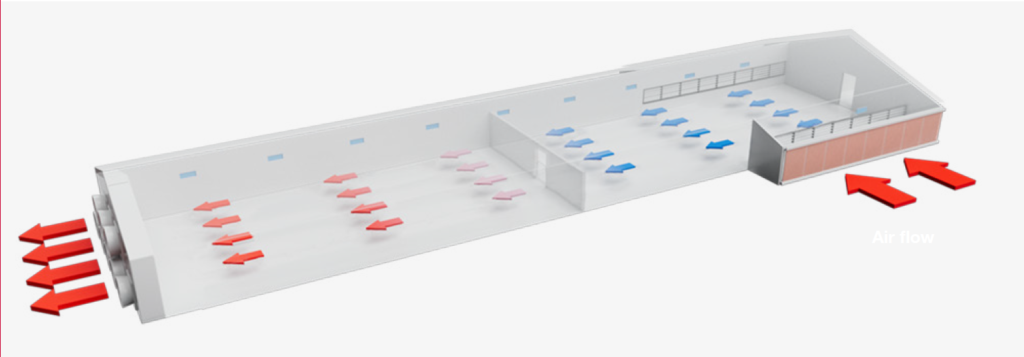
- Primary Objective: To protect birds from severe heat stress using high-velocity wind exchange and evaporative cooling pads during hot summer periods.
- Operating Mechanism: Side-wall inlets are completely sealed. Tunnel doors or pad curtains at one end of the house open, while all available tunnel fans at the opposite end run at high capacity.
- Logic: The house transforms into a wind tunnel. Air velocity is ramped up to 2.5 – 3.0 m/s, effectively lowering the bird’s effective temperature via the wind-chill factor. If dry air velocity proves insufficient, the cooling pad pumps are triggered by automation to utilize the latent heat of vaporization, lowering the house temperature via evaporative cooling.
4. Natural Ventilation (Open Ventilation)
- Primary Objective: Utilizing natural wind patterns to achieve zero energy cost.
- Operating Mechanism: Applied in open or semi-open curtain-sided poultry housing. No mechanical fan power is utilized; air circulation relies entirely on thermal convection (warm air rising) and ambient wind pressure gradients.
- Logic: Automation overhead is minimal, but reliance on external environmental volatility is absolute. Its probability of use in highly secure industrial integrations continues to drop due to biosecurity and climate stability constraints.
Why Natural Ventilation is Obsolete in Industrial Poultry Integrations
Natural ventilation (relying on openable side curtains), while common in traditional farming, is completely avoided in modern industrial integrations due to structural, biological, and mathematical constraints:
- 1. Unmanageable Biosecurity Risks (The Disease Factor): When curtains are opened for natural airflow, the probability of wild birds (like sparrows), rodents, or airborne vectors invading the house reaches its peak, transferring pathogens through feces or dander. In an era threatened by highly contagious viral pathogens like Avian Influenza, achieving total physical isolation via solid, negative-pressure closed-house designs is a non-negotiable biological mandate.
- 2. The Zero-Control Climate Paradox: Natural ventilation depends 100% on ambient wind velocity, direction, and outdoor temperatures. A farm manager cannot control indoor ammonia or heat build-up if the wind dies down or shifts directions at midnight. Industrial scales demand homogeneous micro-climates at every square meter of the facility. Achieving homogeneity through natural drafts is mathematically impossible.
- 3. Destruction of FCR and Flock Uniformity: If the windward side of a house is chilled while the leeward side experiences ammonia and heat stagnation, flock uniformity shatters. Chilled birds burn feed calories for thermoregulation rather than muscle accretion, while heat-stressed birds cease feeding altogether. This splits the flock’s performance curves, drastically inflating the overall FCR and delivering highly heterogeneous birds to the processing plant.
References:
1. Czarick, M., & Fairchild, B. D. (2012). Poultry housing and ventilation dynamics: Managing static pressure and air velocity lines. University of Georgia Cooperative Extension Bulletin.

2. Donald, J. (2002). Environmental Control in Poultry Houses. Poultry Housing Tips, Auburn University.

3. Anonymous (2023). Ross PS Management Handbook, Aviagen.
Pingback: Ventilation Requirements Calculation Tool for Industrial Poultry Houses