
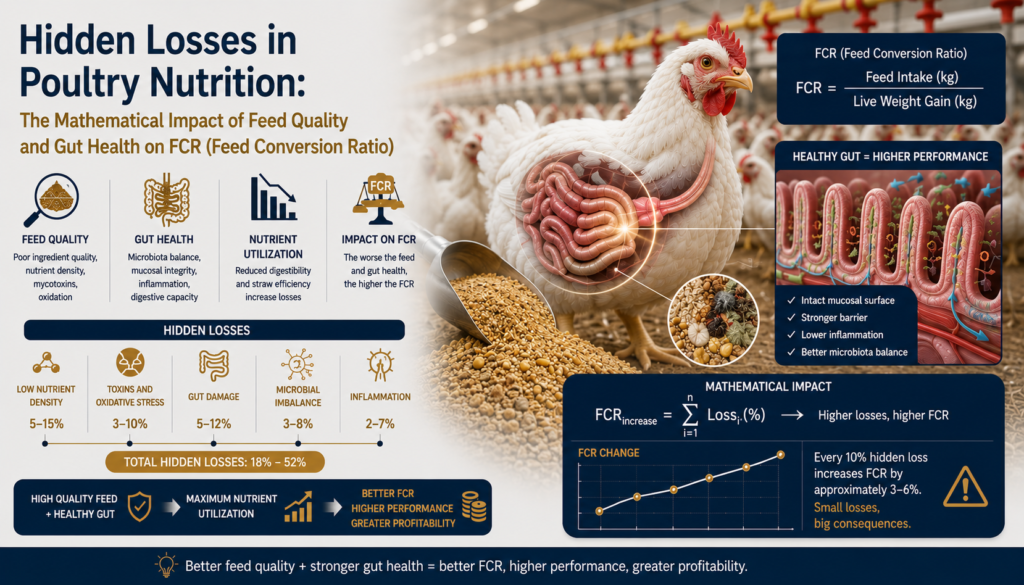
In industrial poultry production, profitability is hidden in the decimals. In a massive integration ecosystem where feed costs constitute approximately 70-75% of total operating expenses, a mere 0.01-point shift in the Feed Conversion Ratio (FCR) represents a high probability of hundreds of thousands of dollars in financial profit or loss across thousands of tons of feed consumed.
From a DVM’s perspective, ration optimization is not just about meeting protein and energy requirements on paper. Real success relies on feed physical quality, intestinal histomorphology, and the digestive mechanism working synchronously as a whole—just like a flawlessly designed industrial assembly line.
1. The Physical Form of Feed: Pellet Durability Index (PDI) and Energy Economics
Even if nutrient specifications (e.g., metabolizable energy, digestible amino acids) are perfect within the formulation software, the physical form of the feed directly alters animal performance. In industrial poultry, the physical integrity of pellet feed is measured by the PDI (Pellet Durability Index).
Delivering feed with a high percentage of fines (low PDI) to the house triggers a detrimental biological mechanism:
- Time and Energy Expenditure: Birds spend physically more time consuming feed when it has a high dust/fines ratio. Increased time spent at the feeders elevates the energy expended on locomotion.
- Reduction in Net Energy: This extra energy spent on feeding behavior is subtracted from the Net Energy budget of the ration. Consequently, energy that should be utilized for growth and muscle (breast/thigh meat) synthesis is mechanically wasted at the feeder. This mechanism causes high-fines feed to mathematically elevate FCR directly compared to high-quality pellets of identical nutritional value.
2. Intestinal Histomorphology: The Automation of the Absorption Surface
The small intestine, where feed is digested and absorbed into the bloodstream, is a massive absorption factory at the microscopic level. The efficiency parameter of this system is determined by the Villus Height to Crypt Depth ratio:
Efficiency Index = Villus Height\Crypt Depth
- Villi: Finger-like projections extending into the intestinal lumen, multiplying the absorption surface area.
- Crypts: Cellular factories responsible for the continuous renewal of these villi.
Poor raw material quality (e.g., high mycotoxin presence, anti-nutritional factors, or oxidized lipids) triggers subclinical inflammation in the intestinal mucosa. This inflammation sloughs off the villi, shortening their height. The factory (crypts) deepens, consuming more energy and amino acids just to regenerate these damaged cells.
A decreased villus height coupled with increased crypt depth reduces the functional absorptive surface. The bird continues to consume feed, but due to this “mechanical failure” in the gut tract, nutrients cannot be efficiently transferred to the bloodstream. Undigested nutrients then reach the hindgut (cecum), promoting the proliferation of pathogenic bacteria (such as Clostridium perfringens), inviting clinical disasters like Necrotic Enteritis that completely shatter FCR curves.
3. Field-Tested Biosecurity and Nutritional Insights
Waiting for clinical disease outbreaks before intervening on the field represents a severe financial risk. To prevent subclinical intestinal damage, integration managers must enforce the following strategic mechanisms:
- Strict Raw Material QC: Implementing rigorous toxin-binder protocols for major incoming ingredients like corn and soybean meal directly dictates the live weight gain trajectory on the field.
- Particle Size Management: The geometric mean diameter of feed grinding must support proper gizzard development. A well-developed gizzard slows down gastrointestinal transit time, maximizing enzyme-substrate contact and significantly enhancing overall digestibility.
Summary: Rational Management of Biological Inputs
Ultimately, industrial poultry nutrition extends far beyond a formulation matrix. Every parameter—from house ventilation quality (and its impact on gut permeability) to the durability of the pellet in front of the flock—defines the success of the ration. Understanding the microscopic rules of biology (gut health) and integrating them with industrial operations is the only definitive way to master FCR at the decimal level.
References:
- Amerah, A. M., Ravindran, V., Lentle, R. G., & Thomas, D. G. (2007). Influence of feed form and particle size on the performance, digestive tract development and behaviour of broiler chickens. World’s Poultry Science Journal, 63(2), 185-207.
- Behnke, K. C. (1994). Factors affecting pellet quality. Maryland Nutrition Conference for Feed Manufacturers, 136-147.
- Pluske, J. R., Thompson, M. J., Atwood, C. S., Bird, P. H., Williams, I. H., & Hartmann, P. E. (1996). Maintenance of villus height and crypt depth in the small intestine of weanling piglets and broilers: Effects on mucosal architecture and efficiency. British Journal of Nutrition, 76(3), 409-422.
- Skinner-Noble, J. A., & Teeter, R. G. (2004). Components of feed efficiency in broiler chickens: Effects of feed form, energy allocation, and behavioral activities on FCR. Poultry Science, 83(11), 1849-1856.