
In industrial poultry integrations, the most delicate link within the production chain is the logistical journey a fertilized hatching egg undertakes from the nest box to the incubator. An egg is far more than a simple calcium carbonate shell; it is a living, breathing biological entity whose embryonic cell division has already commenced and whose survival is directly governed by ambient micro-climates. Every single mechanical or thermal error committed from the hen to the setter tray shatters hatchability metrics and post-hatch chick quality.
This article reviews the rational stages of hatching egg logistics, strict morphological elimination protocols, and the thermodynamic boundaries of embryonic biology.
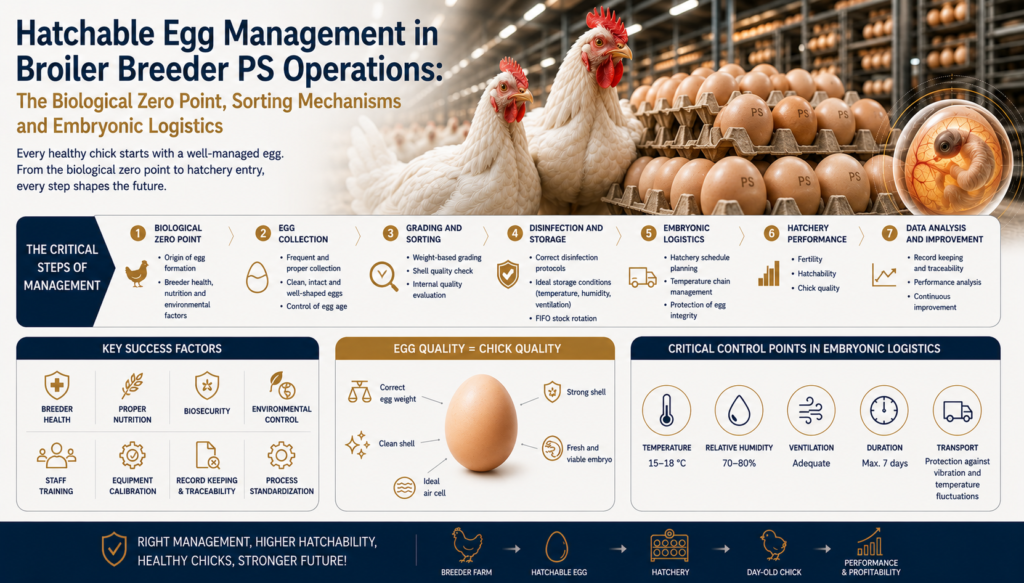
1. The Embryonic Clock: What is “Biological Zero”?
The moment a fertile egg is deposited by the breeder hen, the embryo inside has already completed approximately 24 hours of developmental evolution, reaching the blastoderm stage (containing roughly 20,000 to 40,000 cells). At this juncture, cellular division and structural organization are actively ongoing.
- The Mechanism: For embryonic cellular division to proceed, environmental temperatures must remain above a specific thermodynamic threshold. In avian biology, this boundary is defined as “Biological Zero”, mathematically situated between 20 oC and 21 oC.
- The Rationale for Climate-Controlled Storage: If a hatching egg is left exposed to uncalibrated room temperatures (e.g., 24 oC – 25 oC), the embryo remains above biological zero. It continues cellular replication in an erratic, compromised manner. This results in aberrant embryonic mapping and triggers early-stage embryonic mortality.
- The Biological Pause Operation: Successful holding relies on gradually cooling the egg from the nest temperature (26-30 oC) down below biological zero into the ideal storage bracket of 16 – 18 oC This effectively “pauses” the embryonic clock, locking the organism into a stable state of dormancy (diapause) until optimal heat and light parameters are restored inside the setter.
2. From Nest to Storage: Thermal Shock and the Cuticle Barrier
An egg emerges from the hen’s reproductive tract moist and warm (41 oC). Upon structural exposure to the outer atmosphere, the proteinaceous cuticle layer dries quickly, effectively sealing the shell pores against bacterial penetration.
Critical Veterinary Insight (Thermal Shock): Moving eggs abruptly from a warm house environment (23 – 28 oC) into an aggressively cooled sorting room (16 oC) causes a rapid physical contraction of the egg’s internal mass. If the cuticle layer hasn’t completely solidified, this rapid volume contraction creates a vacuum effect, drawing ambient dust and surface pathogens straight through the open shell pores. To mitigate this biosecurity failure, eggs must be brought down a gradual cooling curve during transport to the sorting room.
3. Strict Elimination Protocols: Managing Non-Hatching Eggs
Not every egg harvested possesses the biological credentials to enter the incubator. To safeguard hatchability, eggs pass through a strict morphological sorting filter:
- Double-Yolk Eggs: Caused by the simultaneous ovulation of two oocytes. These are entirely excluded from setting. As the two embryos develop concurrently, internal surface space and oxygen saturation lines become entirely depleted, causing near 100% late-stage embryonic mortality or explosive structural collapse inside the machine. These are sorted for commercial table egg diversion.
- Cracked and Micro-Fractured Eggs: Macro-cracks are discarded immediately. However, micro-cracks—undetectable to the naked eye and visible only via high-intensity candling or acoustic sensor arrays—represent the greatest bio-hazard. Under the high temperature (37.5 oC) and relative humidity of the incubator, these fractures invite rapid bacterial colonization. The egg rots internally, produces gas, and eventually explodes, aerosolizing virulent pathogens (Aspergillus/Pseudomonas) over thousands of surrounding pristine eggs.
- Misshapen and Shell-Deficient Eggs: Extremely elongated, perfectly spherical, or sand-textured shells are purged. Misshapen shells misalign the embryonic positioning cycle (malpositioning), preventing the chick’s beak from properly breaking into the air cell, leading to intra-egg suffocation.
- Dirty and Fecal-Stained Eggs: Eggs heavily coated in feces or blood are non-negotiable rejections. Setting these converts the incubator into an active biological hazard.
4. Critical Management of Floor Eggs
When breeder hens bypass standard nest boxes and lay eggs directly onto the house litter substrate, the product is classified as a Floor Egg. In industrial parent stock management, an incidence rate climbing above %>1-2 indicates a severe management failure.
- The Pathogenic Vector: The exact second a warm egg meets floor litter, it vacuums the surrounding organic pathogen matrix through its open pores. Regardless of subsequent superficial wiping or sanitization loops, internal contamination is already irreversible.
- Processing and Reclamation Economics: Floor eggs are never commingled or packed into the same setter trays as pristine nest eggs. They are handled via isolated sorting lines. If an enterprise chooses to assume the risk of incubating floor eggs, they are structurally mandated to be set on the bottom-most racks of the incubator trolley. This positioning ensures that if an explosive rot event occurs, the contaminated fluids cannot drip down onto clean inventory. Severely soiled inventory is destroyed or diverted to industrialized high-heat feed rendering processes.
Summary and the Industrial Logistical Matrix
Hatching egg management is a precise mathematical function of time and thermodynamic exposure. Storage room automation loops must be adjusted dynamically according to the anticipated holding duration:
| Storage Duration | Optimal Temperature (°C) | Optimal Relative Humidity (RH%) | Embryonic Turning Requirements |
| 1 – 3 Days | 18 – 20 oC | %65 – %70 | Not Required |
| 4 – 7 Days | 15 – 17 oC | %70 – %75 | Not Required |
| 7+ Days (Extended) | 12 – 14 oC | %75 – %80 | 4–8 times/day at 90o + SPIDES Application |
Interlocking technology with biology requires comprehensive engineering discipline, ranging from tuning the inrush currents of egg collection conveyors to minimize mechanical hairline cracks, to hardcoding the logic circuits of HVAC systems safely below biological zero.
References:
1. Fasenko, G. M. (2007). Egg storage and the embryo. Poultry Science, 86(5), 1020-1024.

2. Aviagen (2021). Broiler Breeder Management Handbook. Aviagen Technical Documentation.

3. Reijrink, I. A. M., Meijerhof, R., Kemp, B., & van den Brand, H. (2009). The effects of egg storage conditions on embryo development and hatchability. World's Poultry Science Journal, 65(4), 651-666.