
In modern industrial poultry production, broiler breeder parent stock (PS) flock management (management) is a high-stakes bioprocess engineering with zero tolerance for error. Unlike commercial broiler units, breeder facilities operate under maximum biosecurity mandates due to their extended life cycles (60–64 weeks), risks of vertical pathogen transmission, and stringent hatching egg quality parameters. Within this elite ecosystem, breaking the chain of infection, preserving flock uniformity, and ensuring the stability of maternal antibodies passed to the next generation rests upon two unyielding pillars: The All-In / All-Out System and Single-Age Management.
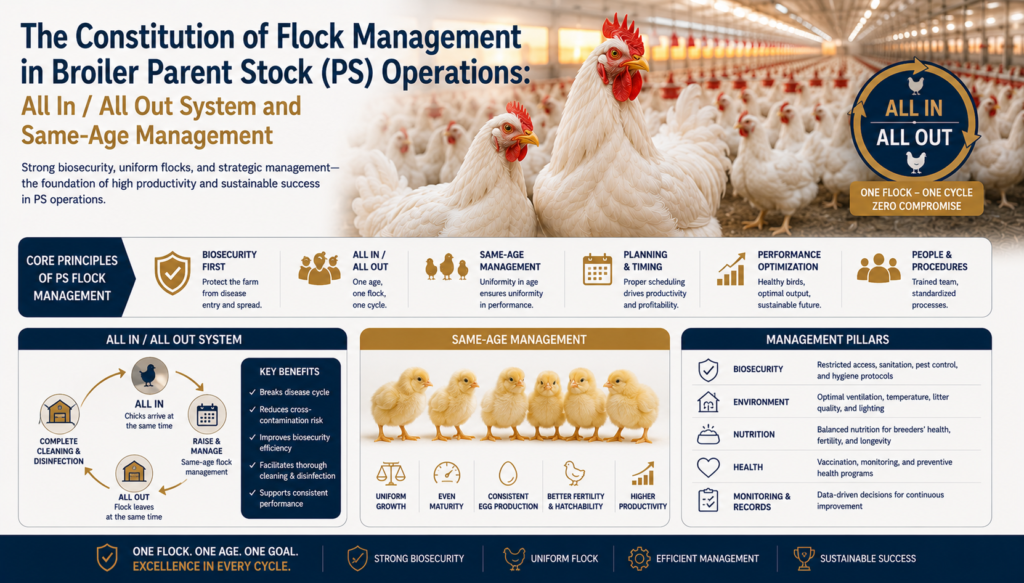
1. The All-In / All-Out System in Breeder Complexes
In parent stock operations, this framework dictates that all poultry houses within an isolated farm boundary must be populated with male and female pullets (or day-old chicks) on the exact same day, complete their entire rearing or laying phases under synchronized schedules, and be completely depleted/slaughtered concurrently at the end of the cycle (typically around week 64).
- The Process Mechanism: Once the facility is fully depleted, not a single live kanatlı remains on the site. This triggers the critical “Downtime”, the most demanding phase of breeder sanitation. Technicians execute mechanical dry cleaning, high-pressure washing, biofilm-dissolving detergent applications, equipment sanitization, liming, and formaldehit gas fumigation without compromise. The entire complex is biologically rested and fully sterilized for a minimum of 3 to 4 weeks before the next placement.
Advantages for Parent Stock Flocks:
- Severing Vertical Pathogen Transmission: The ultimate threat in breeder management is the vertical transmission of vertical pathogens like Salmonella Enteritidis/Typhimurium and Mycoplasma gallisepticum (MG/MS) through the egg to the broiler offspring. The all-in / all-out design mathematically eliminates the probability of these stealth pathogens transferring horizontally from an old flock to a new placement within the farm.
- Uncompromised Terminal Disinfection: Breeder houses feature dense plastic equipment configurations, automatic nests, and complex dual-loop feeding automation (separate sex feeding profiles) that can only be meticulously sanitized when the house stands completely empty.
- Precision Environmental Control and Nutritional Logic: Because the population ages concurrently, negative pressure parameters, inlet calibrations, photostimulation photoperiods, and phase-specific diet transitions (Breeder 1 to Breeder 2) are managed with 100% synchronization across the entire complex.
Disadvantages & Operational Hurdles:
- Downtime Amortization Costs: Leaving a massive parent stock complex unpopulated for 21–28 days incurs significant operational latency. However, the cost of early depletion of a single house due to a Salmonella breakdown or an Avian Influenza quarantine outprices this downtime overhead by hundreds of folds.
- High Logistical Burden and Cost: The transfer of tens of thousands of breeding pullets from rearing pens to production pens on the same day, or the shipment of hens that have completed their production period to the slaughterhouse, requires massive workforce planning and vehicle coordination.
2. The Principle of Single-Age Management
Single-Age Management constitutes the immutable epidemiological boundary line for breeder enterprises. This rule strictly commands that every single house situated within a shared farm topography must accommodate breeder flocks hatched on the exact same day (or with a maximum hatchery takeoff variance of 2–3 days).
- The Multi-Age Disaster Paradox: Rearing 10-week-old pullets alongside a 45-week-old laying breeder flock on the same shared site is an unacceptable biosecurity breach in modern integration standards.
Why Multi-Age Layouts are Absolutely Obsolete in Breeder Operations:
- Immunological Status and Titer Volatility: A 45-week-old breeder flock has encountered numerous live/inactivated vaccines and field challenges, achieving a stable humoral immunity. However, these older birds can act as asymptomatic shedders of subclinical Infectious Bronchitis (IB) variants or Newcastle Disease (ND) strains. If these leak via ventilation drafts or worker boots into an adjacent house holding 10-week-old immunologically naive pullets, it can permanently damage the developing oviducts of the young females (silent layer syndrome), completely erasing their future peak lay potential.
- Vaccination Protocol Conflicts: Live spray booster vaccinations (e.g., aggressive live Gumboro/IBD or IB variant rounds) executed in a young pullet house can drift via exhaust fans into neighboring houses containing sensitive peak-lay hens. This cross-vaccination exposure triggers sharp drops in egg production and degrades shell architecture. Single-Age Management entirely eliminates these cross-contamination dynamics.
Summary and Industrial Decision Matrix
Success in Broiler Parent Stock management depends on the mathematical stability of the synchronization link between hatchery output and house automation loops. The all-in / all-out system paired with the single-age principle represents the unyielding constitution of modern flock management. Governing the laws of biology with the discipline of logistics is the sole scientific matrix for securing high-hatchability eggs and field-leading broiler generations.
References:
- Aviagen (2021). Ross 308 Parent Stock Management Handbook. Aviagen Technical Documentation.
- Cobb-Vantress (2022). Broiler Breeder Management Guide. Cobb Operational Manual.
- Swayne, D. E. (2020). Diseases of Poultry (14th Edition). Wiley-Blackwell.