
In modern industrial poultry production, operational success is directly governed by how effectively you manage the distinct biological boundaries of genders through house management systems. In a breeder flock that has entered its production phase (Laying period), allowing males and females to share a single feeding system results in a catastrophic collapse of flock uniformity, pododermatitis control, and overall fertility rates. To circumvent this biological constraint, the industry implements a standard operational layout known as Separate Sex Feeding (SSF).
What is the underlying nutritional requirements, mechanical configurations, and subsequent flock performance metrics of this system?
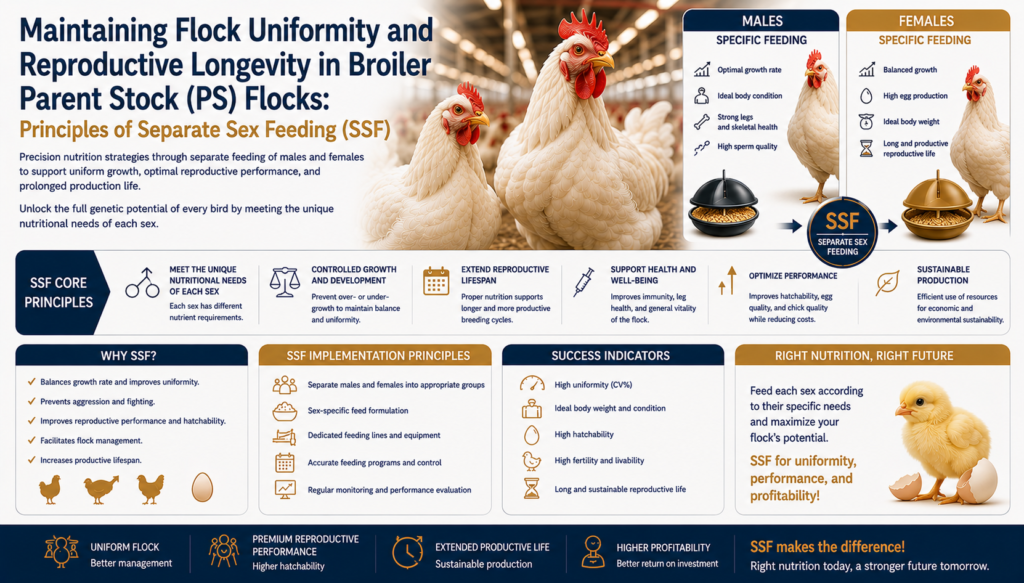
1. Sex-Specific Feeding Requirements: Nutritional Discrepancies in Male and Female Diets
During the laying cycle, the metabolic and reproductive demands of a breeder hen and a breeder rooster are completely antithetical. This divergence is explicitly demonstrated in the target macro-nutrient parameters within their respective rations:
- The Calcium (Ca) Requirement: A breeder hen requires a minimum dietary calcium density of %4.0 – %4.5 to orchestrate continuous eggshell calcification. Conversely, a rooster has no physiological demand for shell formation and requires only around %1.0 calcium to maintain optimal semen quality. If a rooster co-consumes the high-calcium female ration, it triggers severe visceral gout (uratic diathesis), renal calcification (nephrosis), and metabolic degradation. This leads to premature male depletion.
- Energy and Crude Protein Ratios: Male diets maintain restricted crude protein and metabolizable energy parameters compared to hens. The operational objective is to tightly govern the rooster’s muscle accretion (specifically breast meat yield) while optimizing spermatogenesis. Over-fed males rapidly become overweight, which physically impedes natural treading mechanics during mating.
2. Indoor Mechanical Barriers: Separation Architecture of Female and Male Feeders
Separating the rations of males and females within a shared floor space is executed via two distinct mechanical layouts and physical filtering methods:
A. Female Feeder Protection Grills
Automated chain or track feeding lines dedicated to hens are capped with specially engineered steel anti-male grills.
- Operating Principle: Roosters possess inherently larger cranial structures, wider beaks, and more developed combs compared to hens. The vertical slot width of the female feeder grills is strictly calibrated between 43 – 47 mm, with a horizontal clearance of 60 – 70 mm. This physical barrier allows female hens to seamlessly pass their heads through to consume feed, while barring roosters from gaining entry, securing isolation of the female ration.
B. Male Feeder Systems
For male nutrition, two primary layouts are utilized completely independent of the female lines and elevated to a height accessible solely to the roosters: Male Pan Systems or Male Automated Chain-in-Trough Lines.
- Operating Principle: Both automated pipe lines equipped with feeding pans and automated chain-in-trough tracks dedicated specifically to roosters are raised via motorized winches to a height out of reach for female hens. Even if hens attempt to reach these lines, the physical height combined with the deep contour design of the pans or troughs prevents feed spillage and consumption. This ensures the male ration is strictly reserved for the roosters.
3. System Advantages and Live Performance Kinetics
- Precise Male Body Weight Regulation: The paramount advantage of the SSF protocol is the ability to map the weekly body weight growth curves of the roosters strictly to breed manual targets. It entirely eliminates overweight males.
- Flock Fertility Longevity: Roosters maintained at lean target weights, protected from renal gout, and free from severe footpad dermatitis display intense libido and high treading efficiency throughout the 64-week cycle. This directly improves hatchability parameters at the hatchery.
- Flock Uniformity Optimization: Preventing males from consuming female feed preserves the nutritional homogeneity of the hen flock, stabilizing the population’s body weight coefficient of variation (CV%).
4. Operational Risk Management and Calibration
- Capital Expenditures: Installing dual-loop automated feeding networks, independent feed silos, dedicated drive motors, and control panels drives up initial facility setup costs.
- Periodic Calibration Demands: Farm technical crews must meticulously track the age-dependent cranial and beak development of the roosters. If the female grill widths are not narrowed in synchronization with flock maturity, lean or submissive males will squeeze their heads into the hen track. Conversely, if calibrated too narrow, large-framed hens are barred from eating, destroying female uniformity.
Summary and Conclusion
The Separate Sex Feeding (SSF) configuration is a professional flock management application that solves biological imperatives through automated mechanical infrastructures. Safeguarding male reproductive longevity while optimizing female eggshell architecture depends completely on physical calibrations within the feeding lines. The definitive key to sustainable fertility and optimized FCR parameters across breeder enterprises resides within this mechanical separation.
References:
- Aviagen (2021). Ross 308 Parent Stock Management Handbook. Aviagen Technical Documentation.
- Cobb-Vantress (2022). Broiler Breeder Management Guide. Cobb Operational Manual.
- Waldroup, P. W. (2002). Dietary nutrient allowances for broiler breeders. Journal of Applied Poultry Research, 11(2), 234-245.