
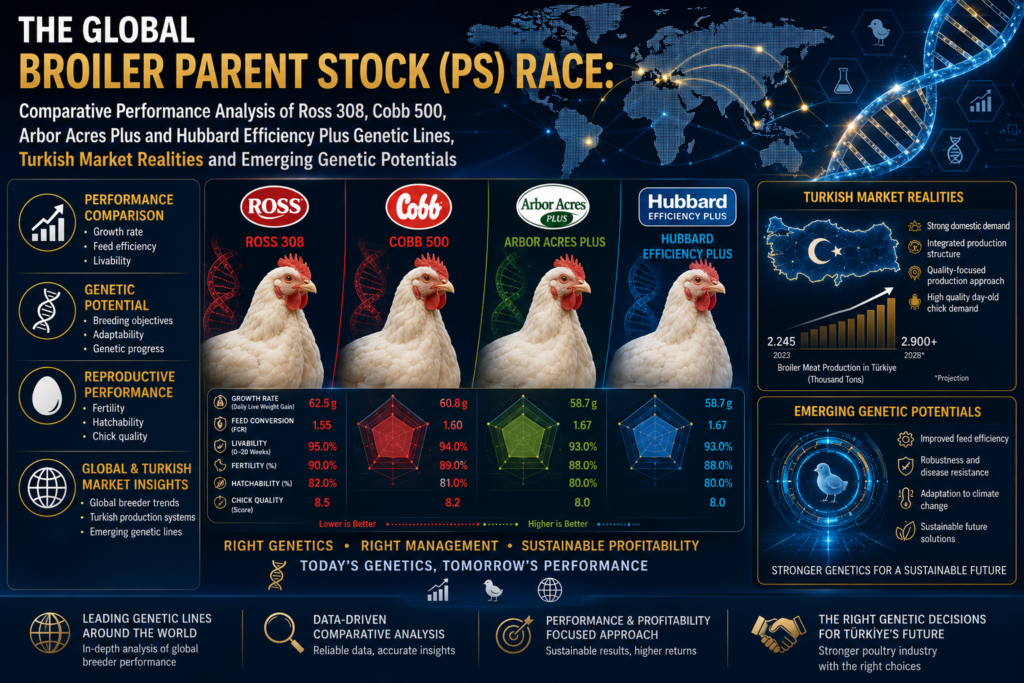
In modern industrial poultry integrations, profitability and bioprocess sustainability are directly linked to the field performance metrics of the selected genetic line. Today’s global poultry market is dominated by four primary Parent Stock (PS) competitors: Ross 308, Cobb 500, Arbor Acres Plus, and Hubbard Efficiency Plus. While each genetics enterprise marks its own variant as the most optimized population, clear phenotypic advantages and management constraints exist across rearing, laying, and subsequent broiler generations under commercial field conditions.
This comprehensive comparative analysis evaluates these 4 leading pedigree strains across reproductive physiology, hatchery incubation profiles, body weight uniformity, broiler progeny meat yield indices, Turkish market share dynamics, national breeding initiatives, and record-breaking field data.
1. General Selection Philosophies of Genetic Lines
The selection programs of each genetic line are tailored to meet diverse geographic, economic, and logistical demands of global integrations:
- Ross 308 (Aviagen): Selected under the “balanced performer” philosophy. Its objective is to yield acceptable hatching egg/chick counts at the breeder level while securing robust breast meat yield and an optimized feed conversion ratio (FCR) in the broiler progeny. It exhibits high environmental resilience.
- Cobb 500 (Cobb-Vantress): One of the world’s premier meat-yield lines. The selection priority centers on extreme breast meat yield in the broiler generation combined with lower nutritional maintenance costs (low amino acid density requirements) during the breeder phase.
- Arbor Acres Plus (Aviagen): Specifically selected for high hatchability performance and exceptional breeder livability metrics across Eastern Europe, the Middle East, and Asian territories. It exhibits remarkable body weight uniformity under volatile environmental challenges.
- Hubbard Efficiency Plus (Hubbard – An Aviagen Company): Engineered purely around “biological efficiency.” It is selected to output maximum hatching egg numbers on minimal breeder feed consumption while delivering leading FCR parameters in the broiler generation.
2. Breeder Production Metrics: Egg, Peak, and Chick Outputs
The core of breeder facility economics rests upon the total hatching eggs harvested and healthy day-old chicks hatched per hen. The cumulative performance matrix between weeks 25 and 64 outlines the following standards:
| Performance Metric (Weeks 25 – 64) | Ross 308 | Cobb 500 | Arbor Acres Plus | Hubbard Efficiency Plus |
| Peak Egg Production (%) | %84.5 – %85.5 | %86.0 – %87.0 | %84.0 – %85.0 | %86.5 – %87.5 |
| Persistence at Peak (Weeks / >%80) | 7 – 9 wks | 8 – 10 wks | 6 – 8 wks | 9 – 11 wks |
| Total Eggs per Hen Housed | 182 – 187 (Field: 200+) | 180 – 185 | 183 – 188 | 190 – 195 |
| Hatching Egg Selection Rate (%) | %93.0 | %92.5 | %94.0 | %93.5 |
| Total Chicks per Hen Housed | 145 – 150 (Field: 175+) | 140 – 146 | 146 – 152 | 152 – 158 |
Physiological Data Analysis and New Genetic Ceilings:
- Ross 308 Real-World Over-Standard Outputs: While standard breed manuals lock cumulative egg targets for Ross 308 between 182-187, recent intensive pedigree selections combined with precise climate and nutritional automation loops have entirely redefined these barriers. Today, verified elite facilities operating under maximal biosecurity and strict weight uniformity report cumulative curves reaching 200 – 210 total eggs per hen housed within the 25–64 week layout.
- Hubbard and Cobb Peak Sustainability: Hubbard Efficiency Plus and Cobb 500 exhibit strong genetic architecture regarding peak persistence. While the Cobb 500 drives an aggressive early spike in lay, Hubbard outpaces competitors in cumulative chick counts due to a highly linear lay curve.
3. Incubation Kinetics and Embryonic Livability
The performance of eggs through hatchery automation loops and subsequent hatchability is governed by shell structural integrity and blastoderm vitality:
- Cumulative Hatchability Performance: Across the flock lifecycle, Arbor Acres Plus and Hubbard hold an uncompromised lead, stabilizing between %82.5 and %83.5. Cobb 500 requires intense calcium tracking and strict Separate Sex Feeding (SSF) adherence past week 50, as its shell calcification pathways respond sensitively to advanced hen senescence.
- Embryonic Preservation Under Storage: Ross 308 displays the highest embryonic tolerance to extended pre-incubation egg holding durations (>7 days) and SPIDES (Short Periods of Incubation During Egg Storage) inputs. Its blastoderm cell matrix retains structural integrity under cold storage latencies.
4. Rearing Phase Body Weight and Uniformity Dynamics
The absolute key to unlocking future lay potentials is body weight regulation during the rear. Management constraints from weeks 0 to 20 vary drastically between lines:
- Growth Curve Integrity: Because Cobb 500 frames its breast conformation early in development, it exhibits an aggressive predisposition for accelerated weight gain. This mandates highly strict feed restriction protocols between weeks 12 and 16, presenting operational hurdles for technical staff.
- Population Uniformity (Coefficient of Variation – CV%): Ross 308 and Arbor Acres Plus show higher elasticity against minor nutritional deviations or localized climate draft shocks. Holding the population variation (CV%) safely below the %8 target threshold demands less manual labor inputs on Ross lines compared to Cobb populations.
5. Subsequent Progeny (Broiler) Field Performance
Breeder credentials culminate in the commercial processing plant data of their broiler offspring. Standard 42-day commercial broiler grow-out yields display the following parameters:
- Feed Conversion Ratio (FCR): Hubbard Efficiency Plus and Ross 308 share global dominance in cumulative FCR tracking (1.48 – 1.52). Hubbard holds distinct metabolic advantages in partitioning energy toward tissue accretion due to enhanced intestinal villi histomorphology.
- De-Boned Breast Meat Yield: Cobb 500 and Ross 308 lead the industrial segment in breast meat yield percentage relative to live weight (%24.5 – %25.5). For integrations focused on automated de-boning and further processing formats, Cobb 500 yields supreme financial premiums per carcass.
6. Aligning Global Data with Market Realities: Why Ross 308 Dominates the Turkish Poultry Sector
The genetic competition observed globally translates into an even more dramatic and polarized reality within the Turkish domestic poultry sector. In the Turkish broiler integration landscape, Ross 308 single-handedly dominates the Parent Stock (PS) market share with an absolute grip of approximately %85 – %90. The remaining market volume is shared by Cobb 500, alongside marginal representations of Hubbard and Arbor Acres in limited local operations.
The underlying technical and epidemiological reasons for this sharp division within the framework of Turkey’s field conditions involves several factors:
A. Factors Driving Ross 308’s Massive Market Dominance
- Raw Material and Ration Elasticity: Turkey is an integration market heavily dependent on imported feed raw materials, particularly soybean and corn matrices. Ross 308 is metabolically the most resilient strain against amino acid volatility and fluctuating raw material qualities. It absorbs formulation variations better than any other pedigree line on the field.
- Resilience to Micro-Climate and Infrastructure Volatility: Poultry production in Turkey is clustered across regions with vast climatic diversities, such as Bolu, Sakarya, Izmir, Balikesir, and Elazig. Ross 308 provides technical managers with an exceptional operational cushion, holding population uniformity (CV%) intact despite intense ambient temperature fluctuations and compromised litter qualities during rear.
- Field Milestones and “Anadolu” Data Records: The crushing superiority of Ross 308 across Turkey is validated by historic production benchmarks. Official Aviagen Anadolu Data logs and Ross Club (140/150) Performance Frameworks document elite local breeder complexes capturing up to 176.39 healthy chicks per hen housed within a 60-week sequence, securing national championships. These supreme field metrics are definitive evidence of operational excellence in transforming genotypic capabilities into uncompromised phenotypic profit.
B. Why Cobb 500 Captures a Smaller Market Share in Turkey
- Aggressive Growth Management Challenges During Rear: Due to its genetic layout, Cobb 500 maps its breast muscle conformation early in development and exhibits a high predisposition for premature adiposity (fattening). Given the standard contract-farm infrastructure and high labor turnover across Turkish farms, executing the highly sensitive and aggressive feed restriction models required between weeks 12 and 16 is operationally difficult. Any deviation in body weight calibration shatters peak lay persistence.
- High Nutrient Density Dependency: To unlock its signature breast meat yield premium in the grow-out phase, Cobb demands a high, uncompromised amino acid density (specifically digestible Lysine and Methionine) in the feed mill. Under the weight of high local feed ingredient costs, sustaining these elite formulations is a financial risk that many integrations choose to avoid.
C. Why Hubbard and Arbor Acres Possess Marginal Representation
- Hubbard’s Carcass Conformation Constraints: Although the Hubbard Efficiency Plus yields exceptional day-old chick numbers per hen and outstanding broiler FCR, its final carcass morphology (breast width conformation) does not track as aggressively as Ross or Cobb toward the plump, broad-breasted carcass silhouette favored by the Turkish retail market. Local integrations are unwilling to trade processing plant breast tonnage for a few extra day-old chicks at the breeder level.
- Arbor Acres’ Intra-Brand Competition with Ross 308: Arbor Acres is also a premium brand within the Aviagen portfolio. However, because Ross 308 possesses a deeply entrenched infrastructural lead in Turkey regarding distribution logistics and dedicated field technical support, enterprises see zero rational incentive to switch to its sibling strain.
7. Turkey’s National Genetic Initiative: TAGEM Breeding Programs and the “Anadolu-T” Native Broiler Strain
The near 100% absolute dominance of global genetic monopolies within the Turkish market exposes the local sector to severe logistical and biological constraints during potential supply chain crises or global pandemics (e.g., severe Avian Influenza lockdowns). To mitigate this strategic dependency, the native broiler breeder selection programs executed for years under TAGEM (General Directorate of Agricultural Research and Policies) constitute Turkey’s sovereign defensive shield in avian genetics.
- The Pioneer Native Parent Stock “Anadolu-T”: As a direct output of long-term pure-line breeding programs coordinated by TAGEM, Turkey’s first officially registered indigenous broiler parent stock, “Anadolu-T”, was engineered. Anadolu-T has been specifically selected for maximum adaptability to Turkey’s micro-climates, high-altitude operations, and volatile housing ecosystems.
- Technical Performance Profiles: The progeny of Anadolu-T successfully reaches a target live weight of 2,500 – 2,600 grams at the conclusion of a a standard 42-day cycle, capturing a Feed Conversion Ratio (FCR) curve between 1.55 and 1.60. While these metrics are highly satisfactory for serving the local whole-carcass retail vectors, they remain slightly behind the extreme breast meat yield parameters of global pedigree lines.
- Strategic Imperative (Biological Insurance): The development of Anadolu-T and sibling Grandparent Stock (GP) projects under TAGEM are not commercial maneuvers designed to instantly replace global volumes overnight. Rather, the core objective is to anchor a “Biological Insurance and Genetic Reserve” matrix, ensuring that animal protein conversion lines do not stall during acute global supply chain failures.
👑 Industrial Decision Matrix: Aligning Line to Enterprise Strategy
In commercial poultry management, there is no single absolute breed; there is only a strategically aligned breed:
- If your integration is heavily geared toward further processing (de-boning, breast meat yield) and your field technical staff possesses high management discipline: The ideal choice is Cobb 500. Its exceptional breast meat premium easily offsets intensive rearing management overhauls.
- If you operate under volatile climate variations, face raw material instability in feed mills, and intend to mitigate operational volatility: The definitive path is Ross 308 or Arbor Acres Plus. Their balanced configuration safely absorbs management variations, unlocks leading field rekor potentials, and suits the Turkish market reflexes perfectly.
- If your operational matrix is focused on securing maximum day-old chicks per hen and minimizing the FCR of the grow-out segment: The optimal path is the Hubbard Efficiency Plus variant. Meanwhile, the Anadolu-T project should be consistently supported as a strategic reserve for sovereign biological security.
References:
- Aviagen (2021). Ross 308 Parent Stock Performance Objectives. Aviagen Technical Data Documents.
- Cobb-Vantress (2022). Cobb 500 Parent Stock Performance Objectives. Cobb Breeding Management Publications.
- Hubbard (2021). Hubbard Efficiency Plus Parent Stock Performance Manual. Hubbard Technical Documentation.
- Aviagen (2025-2026). Aviagen Anadolu Performance Data & Ross 140/150 Club Records. Türkiye Entegrasyon Saha Sonuçları Arşivi.
- TAGEM (2023). Native Poultry Breeding Projects and Anadolu-T Registration Reports. General Directorate of Agricultural Research and Policies Publications.