
In the modern poultry enterprise, commercial broiler (meat-type chicken) production remains subject to baseline public misconceptions and non-scientific speculations across mass media platforms. At the core of these claims is the popular belief that the brief grow-out period (42 days) required for a commercial broiler to reach market weight is driven by the administration of artificial “growth hormones.” This populist perspective directly contradicts avian physiology, endocrinological pathways, farm logistics, and industrial economic realities.
This article systematically evaluates why hormone utilization in commercial poultry operations is biologically impossible, logistically unfeasible, and economically irrational.
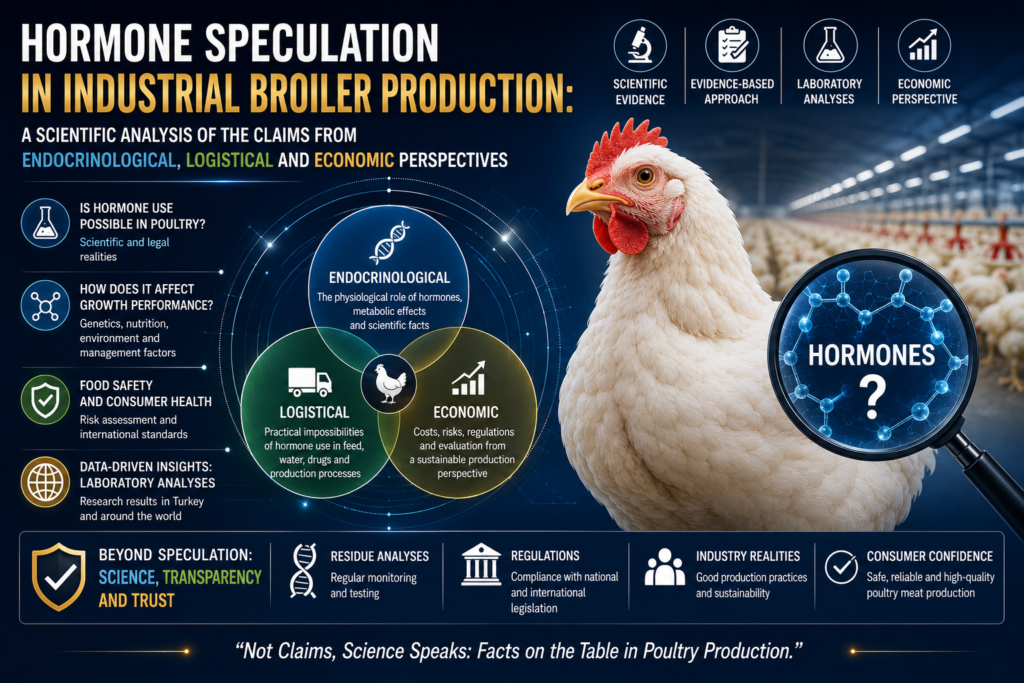
1. Biological and Endocrinological Constraints: Why Hormones Cannot Be Administered Orally (Feed/Water)
The premier scientific error committed by proponents of the hormone narrative resides in their disregard for the anatomical mechanisms of endocrine absorption and digestion:
- Digestion of Protein-Based Compounds: The core endogenous hormones that govern growth in animal organisms (such as avian somatotropin / growth hormone) are protein and polypeptide structures by chemical definition. If an enterprise attempts to administer a hormone orally via feed matrices or water loops, the compound is degraded within seconds by the aggressive proteolytic enzymes (pepsin, trypsin) and intense hydrochloric acidity of the proventriculus (true stomach).
- Conversion into Basic Amino Acids: Once cleaved, the hormone completely loses its native biological architecture, fragmenting into basic amino acid chains. The organism processes these fragments no differently than ordinary dietary protein sources like soybean meal. Consequently, it is biologically impossible for an ingested growth hormone to bypass the gastrointestinal barrier intact and enter the bloodstream to actuate tissue hypertrophy.
2. Logistical and Operational Constraints: The Injection Paradox of Mass Populations
The sole pathway for protein-based hormones to retain their systemic biological activity is to completely bypass the digestive tract through intravenous (IV) or intramuscular (IM) injection pathways. Within commercial facility dynamics, this requirement presents an insurmountable operational deadlock:
- Population Density Logistics: Modern commercial complexes house millions of broilers per cycle, with individual standard barns containing an average of 30,000 to 50,000 birds.
- The Problem of Short Half-Lives: Exogenous growth hormones carry exceptionally brief biological half-lives. To maintain a linear growth stimulus, every single bird across the facility would need to be manually captured and injected daily or every 48 hours.
- Labor Overhead and Severe Stress Factors: Managing individual daily injections for tens of thousands of birds is entirely unfeasible under real-world labor configurations. Furthermore, continuous human entry and continuous physical handling would subject the flock to acute physiological stress. This elevates systemic cortisol outputs, triggers sudden death syndrome (cardiac syncope-cardiovascular failure), and stalls feed intake—ultimately destroying the population’s livability metric.
3. Economic Irrationality: Redundant Financial Expenditures vs. Genetic Pre-Programming
The underlying mechanism enabling contemporary broilers (Ross 308, Cobb 500, etc.) to transition from hatch to a live weight of 2.5–2.8 kg within 40–42 days is not biochemical manipulation. It is the output of over 70 years of intensive conventional pedigree selection, precision amino acid formulation, and automated psychrometric climate calibration.
- Genetic Ceilings and Ad Libitum Intake: Modern broilers are genetically pre-programmed to convert optimized nutrient specifications into skeletal muscle tissue (primarily breast and thigh mass) at maximal physiological limits. These flocks are managed on strict ad libitum (free-choice) feeding programs. The bird’s baseline appetite and daily weight gain parameters already operate at the absolute peak of its biological ceiling.
- Cost-Benefit Metrics: Growth hormones are highly expensive specialized compounds synthesized under premium biotechnological lab configurations. Utilizing a chemical with massive raw ingredient costs on a bird that is already growing at its structural maximum—and whose feed conversion efficiency (FCR) is already optimized—represents absolute financial insolvency. The marginal tissue accretion gained would fail to cover even a fraction of the compound’s manufacturing costs and manual labor inputs.
4. Sovereign Regulatory and Residue Surveillance Networks
Beyond its biological and logistical impracticality, hormone usage remains entirely barred by strict national and global legislative frameworks:
- Statutory Regulations: In alignment with European Union (EU) directives and sovereign veterinary codes, the introduction of any hormonal substance or synthetic growth promoter into poultry feed or water lines is strictly illegal.
- Chromatographic Screening Protocols: Regulatory bodies routinely harvest tissue, plasma, and retail meat samples directly from processing plants and market shelves. These matrices are subjected to advanced chromatographic surveillance (LC-MS/MS) in accredited laboratories to map pharmacological residues. Identifying an unauthorized compound triggers immediate facility closure, severe financial penalties, and the revocation of export credentials—a risk no commercial integration would ever entertain.
Summary and Conclusion
Accelerated growth kinetics in contemporary broiler production are a direct milestone of veterinary sciences, zootechnical genetic selection, precision nutritional engineering, and micro-climate house automation. A hormone narrative that implies oral assimilation, demands impossible manual injection loops, and drives an enterprise into absolute bankruptcy holds zero credibility within the scientific community. Papiers declaring the contrary remain populist speculations. The commercial broiler carcass remains one of the cleanest, most intensely audited, and biologically efficient matrices of animal protein available to global consumers.
References:
- National Chicken Council (2022). The Chicken Myth: Hormones and Steroids. NCC Technical Statements.
- Scanes, C. G. (2009). Perspectives on the endocrinology of poultry growth. Domestic Animal Endocrinology, 37(2), 61-68.
- Tarım ve Orman Bakanlığı (2011). Türk Gıda Kodeksi Hayvansal Gıdalarda Bulunabilecek Farmakolojik Aktif Maddelerin Sınıflandırılması ve Maksimum Kalıntı Limitleri Yönetmeliği.