
In modern industrial poultry production—across both meat-yielding broiler lines and egg-laying strains—every commercial bird utilized is a hybrid. However, contrary to the popular, non-scientific misconception that equates “hybrid” with laboratory gene splicing (GMO), hybrid poultry development does not involve genetic modification. It is an advanced discipline of zootechnical engineering based entirely on conventional selection, quantitative genetics, and the biology of heterosis (hybrid vigor).
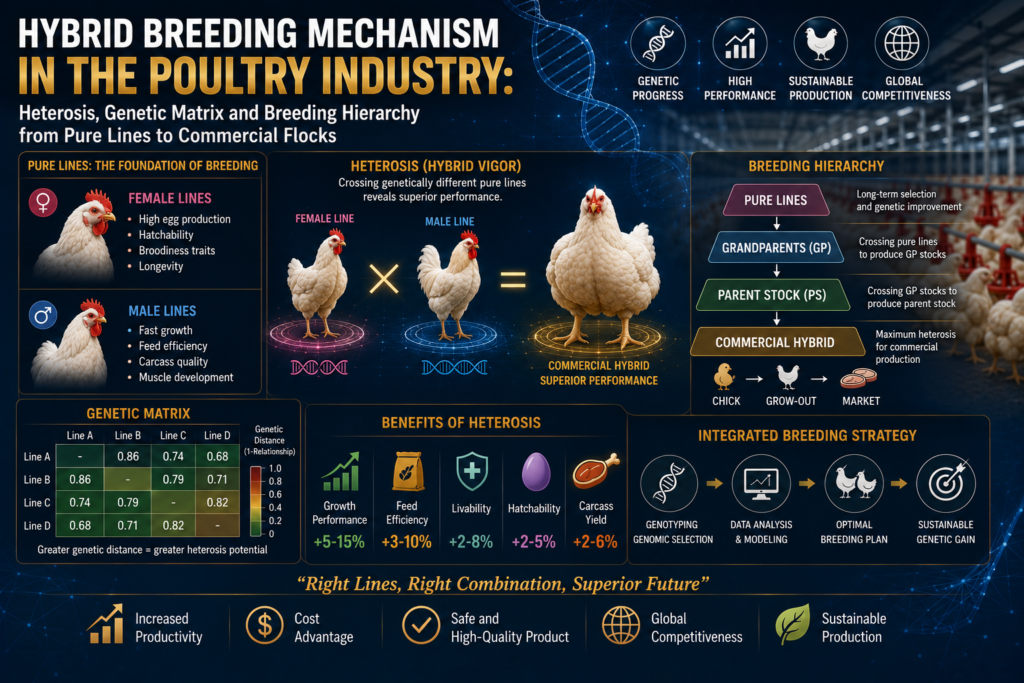
1. What is a Hybrid Strain? (The Biological Engine of Heterosis)
Biologically, a hybrid bird is a highly productive heterozygous offspring group derived by crossing distinct ancestral lines that have been rendered homozygous (pure) through generations of deliberate inbreeding to lock in target traits (e.g., FCR, body weight gain, egg mass, shell quality).
The core driver of this process is Heterosis (%H). Heterosis occurs when the mean performance of the F1 crossbred generation exceeds the average performance of its inbred parental lines. Mathematically, it is defined as:
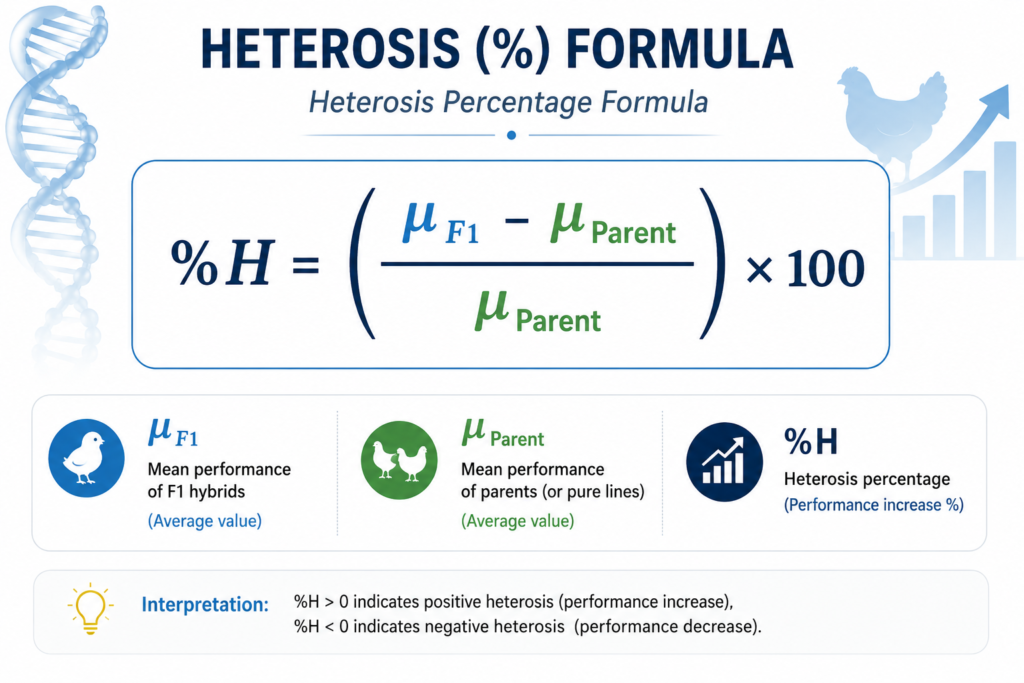
Where µF1 represents the mean performance value of the hybrid generation, and µParents represents the mean value of the homozygous parental lines. The entire goal of industrial hybrid breeding is to maximize this positive heterotic deviation.
2. How Many Crosses Are Required for a Commercial Hybrid? (The Pedigree Pyramid)
To output a commercial hybrid (such as Ross 308 or Lohmann Brown) at an industrial scale, a strict Four-Way Cross breeding pyramid is required. This hierarchy flows systematically from the master pedigree lines down to the commercial barns:
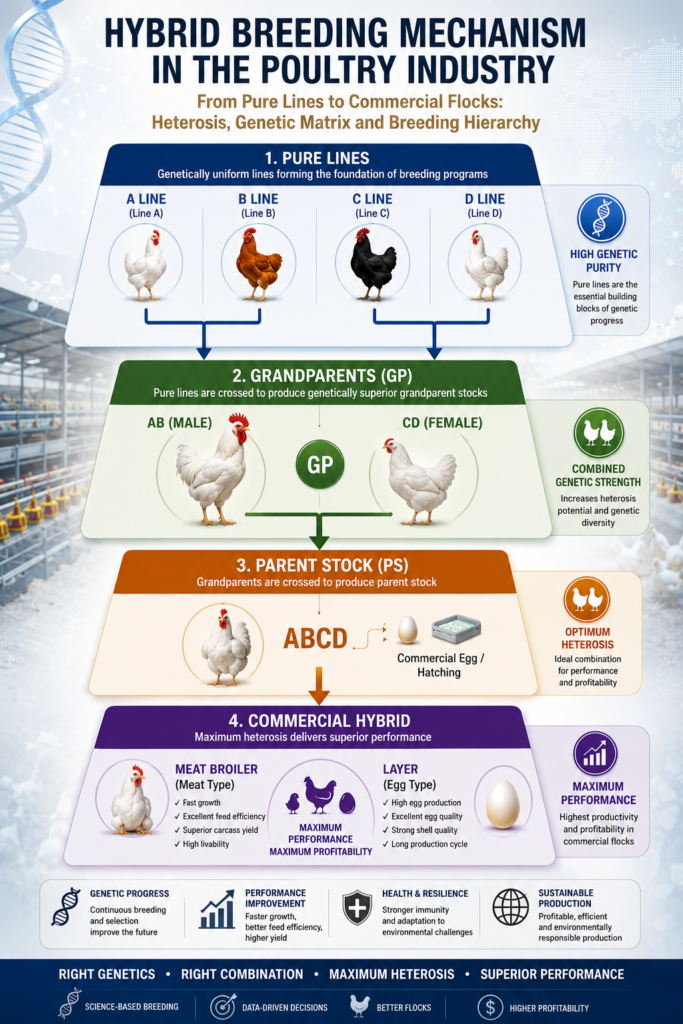
- Phase 1 (Pure Lines – Pedigree / GGP): This is the core nucleus population maintained by elite genetic companies (e.g., Aviagen, Cobb, Hendrix Genetics). Four distinct pure lines—designated as A, B, C, and D—are bred strictly within their own genetic pools for dozens of generations to maximize homozygosity.
- Lines A and B are typically selected as Male Lines (focusing on meat yield, structural frame, and breast muscle accretion).
- Lines C and D are selected as Female Lines (focusing on egg numbers, persistence, hatchability, and the elimination of maternal brooding instincts).
- Phase 2 (Grandparents – GP): Pure Line A is crossed with B to yield the AB line, while C is crossed with D to yield the CD line. This is where hybrid vigor first begins to accumulate.
- 3. Phase 3 (Parent Stock – PS): The resulting AB males are crossed with CD females. This cross produces the multiplier Parent Stock (PS) pullets and cockerels purchased by commercial hatcheries.
- Phase 4 (Commercial Hybrid): The hatching eggs harvested from the Parent Stock (AB x CD) are incubated. The resulting chicks represent the ultimate Commercial Hybrid (Broiler or Layer). These birds hold the complete ABCD genetic matrix, expressing peak heterosis.
3. Which Pure Ancestral Breeds Are Utilized?
The synthesis of highly efficient commercial hybrids relies on the genetic reservoirs of established pure chicken breeds:
A. Broiler Hybrid Foundations (e.g., Ross, Cobb, Hubbard)
Because rapid protein synthesis and muscular hypertrophy are the primary targets in meat-type hybrids, heavy-conformation pure breeds are utilized:
- White Cornish: Serves as the primary Male Line (A or B) at the apex of the pedigree. It transmits broad breast conformation, exceptional dressing percentage, and skeletal density.
- White Plymouth Rock: Serves as the primary Female Line (C or D). It possesses higher egg production traits compared to the Cornish, serving as the biological engine to scale day-old broiler chick volumes.
B. Layer Hybrid Foundations (e.g., Lohmann, Babcock, Hy-Line)
Layer hybrids require a compact frame (to minimize maintenance energy costs) and extreme persistence in egg laying:
- White Leghorn: The absolute genetic foundation for all commercial white-egg laying hybrids (e.g., Lohmann LSL, Hy-Line W-36). It provides outstanding annual egg numbers and an elite Feed Conversion Ratio (FCR) per kilogram of egg mass.
- Rhode Island Red (RIR) & New Hampshire: These breeds form the paternal and maternal foundations for brown-egg commercial hybrids (e.g., Lohmann Brown, ISA Brown). They pass down robust shell calcification genes, dark brown shell pigmentation, and behavioral resilience.
4. Advantages and Disadvantages of Hybrid Strains
Advantages:
- Unmatched Production Efficiency: While a purebred Leghorn may output 200–220 eggs annually, a commercial Lohmann Brown hybrid yields 320–350 eggs due to heterotic drive. Similarly, while a purebred Cornish requires extended periods to reach 1 kg, a Ross 308 broiler hits 2.8 kg in 42 days.
- Population Uniformity: Commercial hybrids exhibit exceptional phenotypic stability. An entire population of 30,000 birds will initiate lay or reach target processing weights on the exact same chronological timeline.
- Enhanced Livability (Vigor): The genetic depression associated with prolonged inbreeding is completely reversed through crossbreeding. Hybrids display superior immune resilience and environmental adaptability compared to pure lines.
Disadvantages:
- Lack of Progeny Breeding Stability (Genetic Segregation): Hybrids cannot reproduce true-to-type. If commercial Ross 308 broilers or Lohmann Brown layers are bred with each other, Mendel’s laws of genetic segregation occur in the F2 generation. The progeny displays extreme phenotypic variance; some exhibit retarded growth, others experience severe lay drops, and flock uniformity is completely lost. This mechanism underlies the commercial dependency on primary breeding companies.
- Biosecurity Risks of Monoculture: The global reliance of egg and meat supply chains on a highly narrow selection of proprietary hybrids poses systemic biosecurity risks in the event of novel pandemic pathogens. Maintaining local pure-line genetic reserves is essential for biosecurity.
References:
- Falconer, D. S., & Mackay, T. F. (1996). Introduction to Quantitative Genetics (4th Edition). Longman.
- Hunton, J. (1990). Industrial breeding and selection. in: Poultry Breeding and Genetics, Elsevier.
- Hill, W. G. (2010). Understanding and using quantitative genetics. Philosophical Transactions of the Royal Society B: Biological Sciences, 365(1537), 73-85.