
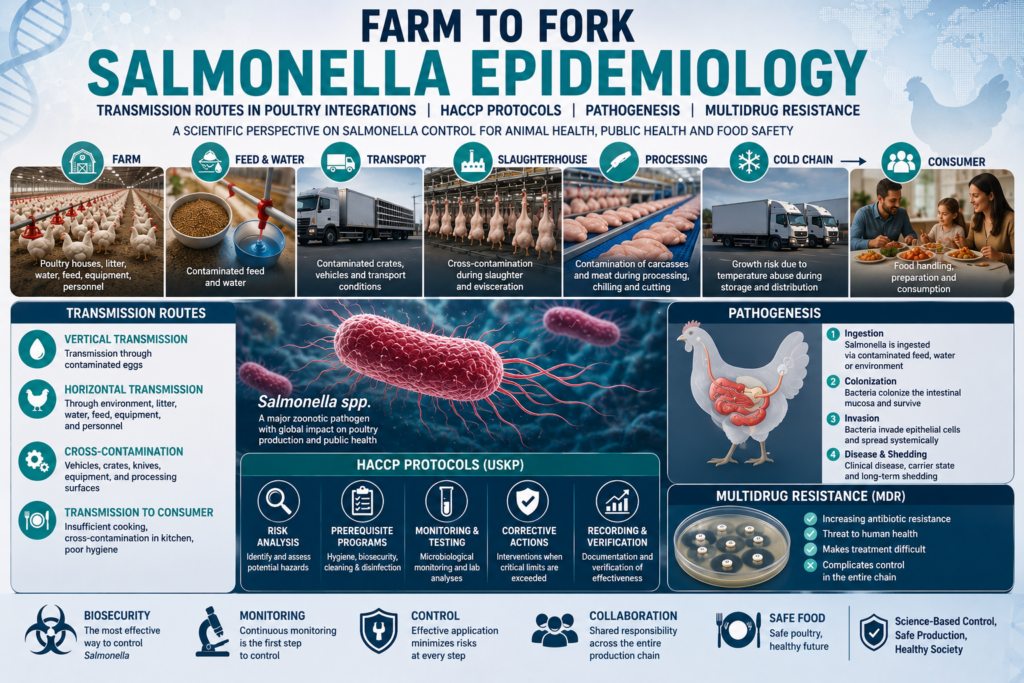
Within the infrastructure of industrial poultry production, Salmonella species constitute one of the most critical control points globally regarding flock livability, food safety, and public health (zoonotic infections). As a facultative anaerobic, Gram-negative, and motile (flagellated) enterobacterium, Salmonella can compromise the entire integration with severe financial and legal sanctions if it establishes a foothold within any junction of the poultry chain (breeder facilities, hatcheries, commercial broiler barns, processing plants, or logistical networks).
This comprehensive analysis article evaluates the prominent Salmonella serotypes threatening the food chain, the transmission cycle of the pathogen from the hatchery to the table, National Salmonella Control Programs (NSCP), vaccination strategies, pathological effects on human health, and the global threat of multi-drug resistance.
1. Primary Salmonella Serotypes Relevant to the Poultry Industry
Although hundreds of Salmonella serovars are monitored within the poultry industry and public health, the process is analyzed under two main groups from epidemiological and legal perspectives:
A. Host-Specific (Non-Motile) Serotypes (Avian Health-Oriented)
These serotypes cause systemic infections in poultry but are not the primary cause of major food poisoning outbreaks in humans:
- Salmonella Gallinarum (Fowl Typhoid): A systemic disease characterized by high mortality, anemia, greenish-brown diarrhea, and hepatosplenomegaly (enlarged liver and spleen), particularly in breeder and commercial layer flocks.
- Salmonella Pullorum (Pullorum Disease / Bacillary White Diarrhea): A vertically transmitted pathogen manifesting via high neonatal mortality, omphalitis (yolk sac infection), and caseous cecal cores during the initial 2–3 weeks of a chick’s life.
B. Non-Host-Specific (Motile) Zoonotic Serotypes (Public Health-Oriented)
These critical serotypes usually localize in the cecum of poultry asymptomatically without eliciting any clinical symptoms, yet cause severe gastroenteritis when transmitted to humans. The 5 main invasive serotypes targeted by the official NSCP framework are:
- Salmonella Enteritidis (Core target)
- Salmonella Typhimurium (Core target)
- Salmonella Infantis (The most frequently isolated multi-drug resistant field strain in the Turkish market in recent years)
- Salmonella Virchow
- Salmonella Hadar
2. The Pathogen’s Journey from Farm to Fork: Transmission Cycle
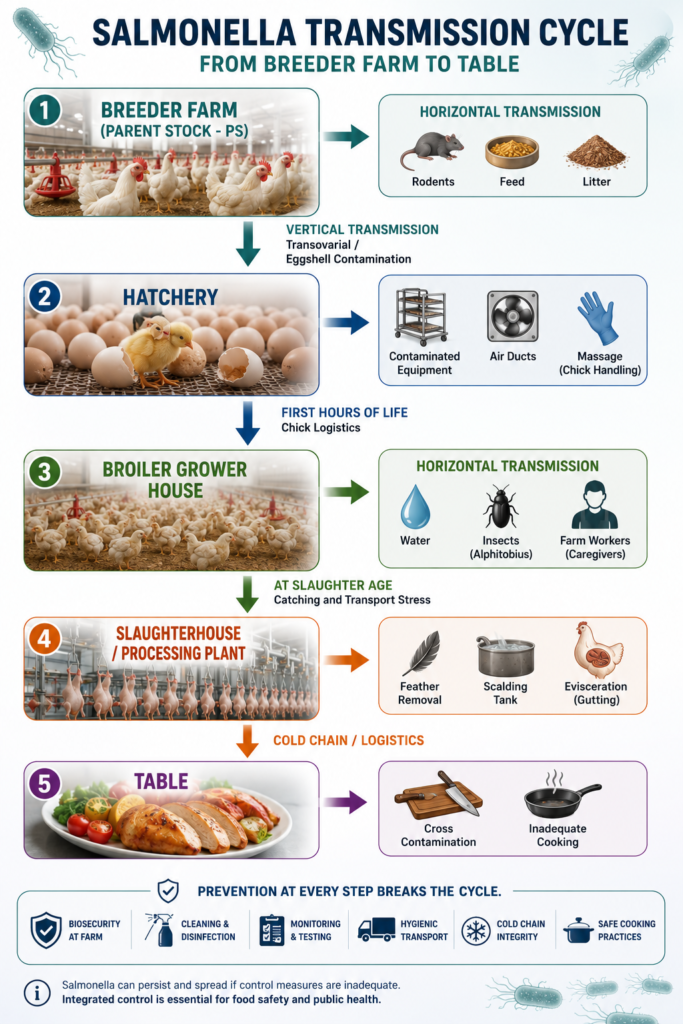
The proliferation and dissemination of Salmonella within an integrated production loop rely on two mutually reinforcing mechanisms: vertical and horizontal pathways.
A. Breeder (PS) and Hatchery Phase (Vertical Pathway):
Infected breeder hens can transmit the pathogen directly into the yolk or albumen during egg formation within the oviduct (Transovarian Transmission). Alternatively, external fecal contamination occurs during oviposition through the cloaca. As the warm egg cools, its structural shell pores constrict, drawing surface pathogens deep into the shell membranes. Once these contaminated eggs enter setters operating at 37.5 oC and high relative humidity, an ideal microbial incubation environment is unlocked. The structural collapse or explosion of a single infected egg releases massive cellular loads into the automated airflow, contaminating thousands of chicks across the hatcher baskets via shell contact or unhealed navels.
B. Broiler Barn and Field Phase (Horizontal Pathway):
Chicks hatching with latent (sub-clinical) infections arrive at the commercial broiler barn and shed Salmonella into the litter via feces. Horizontal vectors driving barn-level transmission include raw feed ingredients, compromised drinking water lines, migratory wild birds, farm rodents, and the ultimate nightmare of broiler houses: Alphitobius diaperinus (Lesser Mealworm). The pathogen can survive intracellularly inside the litter beetle for months, transferring the infection to subsequent flocks.
C. Processing Plant and De-boning Phase (Cross-Contamination):
The physiological stress associated with harvesting and transport logistics at market age exponentially escalates cecal shedding rates. Inside the processing asset, two high-risk zones dictate carcass quality:
- The Scalder Tank: High organic loading combined with shared warm water circulation allows contaminated feathers to atomize, driving flagellated pathogens deep into the open skin hair follicles of adjacent carcasses via aerosols.
- Evisceration: Mechanical misalignment resulting in intestinal rupture releases lumen contents directly onto the carcass profile. Furthermore, the shared water usage inside chillers (cooling tanks) acts as a cross-contamination multiplier loop if chemical sanitation constants drop.
3. National Salmonella Control Program (NSCP) Regulations and Legal Sanctions
The National Salmonella Control Program (NSCP), executed by the Republic of Turkey Ministry of Agriculture and Forestry, enforces a zero-tolerance principle across breeder and commercial layer operations:
- Sampling Protocol: Breeder facilities must undergo mandatory diagnostic monitoring using boot swabs (boot swabs) across fixed lifecycle checkpoints: at day 1, week 4, 2 weeks prior to transport, and every 14 days throughout the production phase for both official and internal auditing purposes.
- Statutory Sanctions (Quarantine and Destruction): Confirmed isolation of S. Enteritidis or S. Typhimurium instantly classifies the Parent Stock flock as “Positive.” Egg shipments to the hatchery are immediately revoked, and all incubating batches under that flock profile are directed to rendering assets for destruction. The live flock is subjected to emergency slaughter or complete biosecurity elimination. If positivity is identified at the broiler pre-harvest or processing stage, carcasses must undergo mandatory thermal heat sterilization (cooking/canning), completely banning fresh retail distribution format options.
4. Integrated Internal Testing, Auditing, and Biosecurity Automation
Beyond minimum legal mandates, commercial enterprises execute aggressive internal HACCP screening loops to defend brand equity:
- Feed Mill Intake Barriers: Raw ingredient matrices (animal by-products, soybean meals, etc.) are screened prior to processing. During conditioning, the core mass temperature is locked at a minimum of 80 – 85 oC to achieve complete thermal inactivation of pathogens. Rations are routinely buffered with synergistic organic acid formulations (formic-propionic acid blends) to minimize post-mill re-contamination vectors.
- S tight Farm Swab Infrastructure: Technical asset managers log weekly swabs across high-risk farm nodes, including nest belts, fan shutters, and rodent bait stations, separate from standard ministerial cycles.
- Processing Line Rinsing Tracks: Post-evisceration carcass wash systems deploy precision dosing loops of organic acids (peracetic acid or chlorinated sanitizers) to disrupt microbial attachment kinetics prior to chilling.
5. Salmonella Vaccination Architecture
To augment baseline biosecurity barriers, integration technical directors deploy advanced vaccination schedules to support flock immunity. Programs utilize two distinct methodologies:
- Live Attenuated Vaccines: Administered via coarse spray or drinking water lines during the rearing phase (typically at day 1, week 6, and week 14). They drive an aggressive cellular immunity response and trigger colonization inhibition within the cecal crypts. Live vaccination loops must be carefully synchronized to avoid overlapping with competitive therapeutic antimicrobial treatments.
- Inactivated Bacterins (Killed Vaccines): Administered via intramuscular or subcutaneous injection prior to flock transfer (weeks 16–18). These oil-emulsified formulations generate high systemic humoral antibody (IgG) curves. The primary clinical objective is to maximize the passive transfer of maternal antibodies to the progeny, shielding the day-old chick across high-stress hatchery handling windows.
6. Public Health Impacts of Salmonella: Pathogenesis and Clinical Manifestations
Salmonella is transmitted to humans primarily through the consumption of contaminated poultry meat, undercooked eggs, or raw foods subject to cross-contamination. Once inside the human gastrointestinal system, the pathogen orchestrates the following pathways:
- Intestinal Colonization and Cellular Invasion: Bacteria surviving the gastric acid barrier attach to the epithelial cells (enterocytes) of the small and large intestines. Utilizing flagella and surface virulence assets, they breach the mucosal lining (invasion), inducing an acute localized inflammatory response (gastroenteritis).
- Clinical Presentation (Salmonellosis): Within 12–72 hours post-ingestion, the infection manifests via acute watery or bloody diarrhea, severe abdominal cramping, high fever exceeding 39 oC emesis, and cephalalgia. While self-limiting in healthy adults within 4–7 days, therapeutic fluid management is critical.
- Systemic Dissemination Risks: In immunocompromised populations (children, elderly, and patients undergoing chemotherapy), the pathogen can structurally compromise the intestinal barrier, accessing the vascular network (bacteremia). Systemic travel can result in focal seeding across bone matrices, cardiac valves, or meninges, triggering life-threatening septic arthritis, endocarditis, or meningitis.
7. Core Technical Insights: Hidden Hazards and Consumer Deviations
A. Cross-Contamination Vectors and The “Poultry Washing” Paradox
A critical public misconception remains the practice of rinsing raw poultry meat prior to thermal input. When raw chicken is rinsed under a kitchen tap, mechanical water force atomizes surface Salmonella assets into high-velocity aerosols. These microbial droplets contaminate sink basins, countertops, cutlery, and adjacent ready-to-eat matrices (salads, fruits). Because the pathogen is highly thermosensitive, raw poultry must never be washed; rather, it must transition directly to thermal processing, locking a baseline core internal temperature of 74 oC to achieve complete cellular inactivation.
B. Emerging Global Vulnerabilities: Multi-Drug Resistance (MDR)
Recent molecular screening of poultry field isolates—predominantly Salmonella Infantis variants—reveals an aggressive stabilization of Multi-Drug Resistance (MDR) matrices against critically important human medical antimicrobials, including third-generation cephalosporins and fluoroquinolones. Unregulated or un-audited therapeutic applications at the farm level accelerate plasmid-mediated resistance transmissions. Consequently, if a human consumer develops systemic bacteremia from these resilient strains, standard hospital anti-microbial interventions face absolute treatment failure under a compromised “One Health” matrix.
Summary and Field Recommendations
Salmonella management does not simply consist of a disinfection footbath placed at the barn door. It is a holistic bioprocess discipline stretching from feed mill pelleting temperatures and hatchery humidity fluctuations to processing plant scalder water turnover constants and cold chain logistics. Securing a sustainable Salmonella-negative status across integration networks requires moving away from reactive antibiotic therapeutic interventions toward proactive internal auditing and the millimetric severing of vertical and horizontal transmission vectors.
References:
- Gast, R. K. (2008). Salmonella infections. in: Diseases of Poultry (12th Edition), Blackwell Publishing.
- Tarım ve Orman Bakanlığı (2016). Ulusal Salmonella Kontrol Programı Uygulama Talimatları ve Mevzuat Dosyası. Gıda ve Kontrol Genel Müdürlüğü.
- Humphrey, T. (2000). Public health aspects of Salmonella infection. in: Salmonella in Domestic Animals, CABI Publishing.