
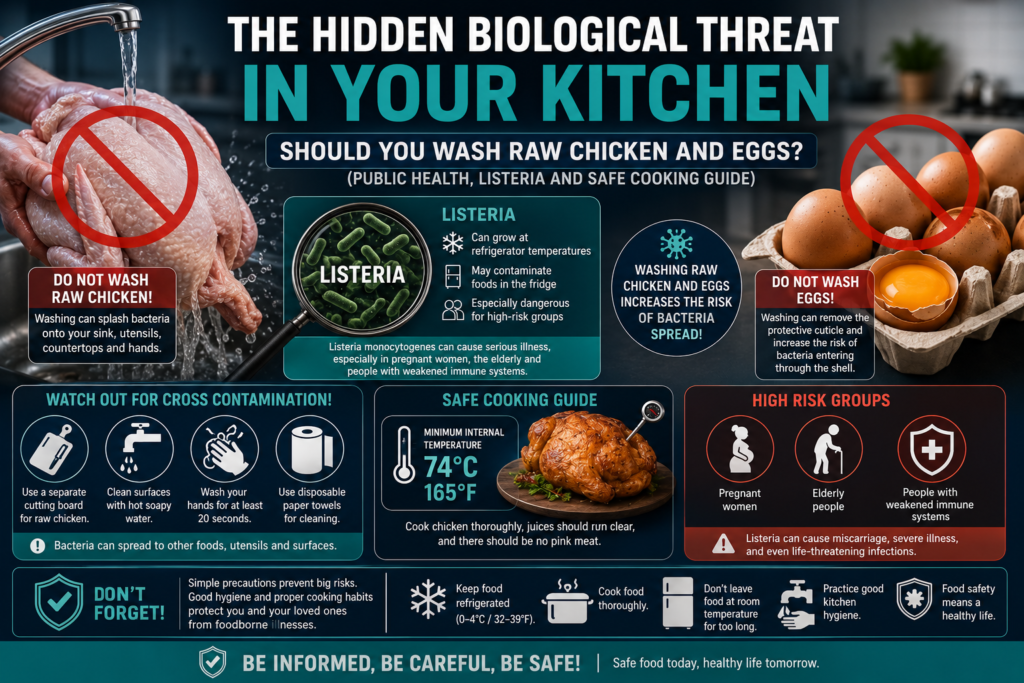
When food hygiene is mentioned in public discourse, the immediate reflex is to rinse food products under water prior to culinary processing. However, this convention is entirely inverted when applied to raw poultry meat (chicken/turney) and shell eggs. Rinsing raw chicken and eggs under the premise of “cleaning” triggers an aggressive chain of Cross-Contamination, spreading microbial pathogens across kitchen environments, cutlery, and ready-to-eat food matrices.
This article systematically evaluates the microbiological hazards present on raw poultry carcasses and eggshells, the fluid mechanics behind washing-induced splash radius, Listeria monocytogenes colonization and biofilm dynamics on kitchen tools, cold-storage management, and thermal inactivation parameters.
1. Which Pathogens Are Present on Raw Poultry Meat?
Regardless of the biosecurity measures and processing plant sanitation protocols deployed during industrial production, raw poultry carcasses naturally host surface microbial populations. The primary zoonotic pathogens isolated from raw chicken include:
- Salmonella spp.: Specifically Salmonella Enteritidis and Salmonella Infantis, which colonize carcass skin profiles and muscle tissue. In humans, ingestion triggers severe gastroenteritis, bloody diarrhea, high fever, and systemic bacteremia in immunocompromised populations.
- Campylobacter jejuni: The global leading cause of bacterial foodborne toxicosis. Commonly localized within avian intestinal microflora, even low infectious doses (a few hundred bacterial cells) induce severe abdominal cramping, acute enteritis, and post-infectious neurological complications such as Guillain-Barré Syndrome.
2. What Happens When Raw Chicken Is Washed? (Aerosol Mechanics and Cross-Contamination Physics)
When raw chicken is placed inside a sink basin and rinsed under tap water, the fluid mechanics function as follows:
- Aerosol Formation (Splattering Mechanism): The impact velocity of running tap water colliding with the hydrophobic lipid and protein surface of raw chicken generates microscopic water droplets (aerosols).
- Splash Radius Dynamics: Fluid mechanics and food safety research confirm that water droplets atomized during chicken rinsing travel outward in a 70–90 cm radius from the center of the sink basin.
- The Cross-Contamination Map: These invisible, pathogen-laden micro-droplets land on adjacent sink surfaces, clean countertops, drying racks, cutlery, cutting boards, and most critically, ready-to-eat foods (salads, fresh greens, fruits) positioned nearby.
- Uncooked Hazards: While thermal processing eliminates pathogens inside the chicken, the Campylobacter or Salmonella cells atomized onto countertops and salad ingredients bypass thermal destruction, rendering foodborne illness inevitable.
Public Health Rule 1: Raw poultry meat MUST NEVER BE WASHED. Chicken should be transferred directly from its packaging into the cooking vessel or oven pan. If surface moisture must be reduced, pat the carcass gently with a single-use paper towel and discard the towel immediately into a covered waste bin.
3. Should You Wash Shell Eggs? (The Cuticle Layer and Pore Physiology)
A widespread misconception involves washing shell eggs prior to refrigerator storage to strip away external fecal matter or litter debris.
- Natural Biological Defense: The Cuticle Layer: During oviposition through the hen’s cloaca, the egg is coated with a liquid proteinaceous matrix that dries into a protective layer called the cuticle. This layer seals the approximately 7,000 to 17,000 microscopic shell pores, isolating the internal matrices from environmental pathogens.
- The Destructive Impact of Washing: Rinsing eggs under water (particularly cold water) dissolves and strips away this protective cuticle membrane.
- Thermal Vacuum Effect: Cold water contracts the internal air cell of the egg, creating a localized negative pressure vacuum. Salmonella cells residing on the outer shell dissolve in the wash water and are drawn directly through the open pores into the albumen and vitellus.
Public Health Rule 2: Shell eggs MUST NEVER BE WASHED upon purchase; they should be stored in their original cardboard carton inside the refrigerator. If an eggshell is heavily soiled, rinse it quickly under warm water only immediately before thermal preparation and proceed directly to cooking.
4. The Hidden Hazard on Equipment and Cold Storage: Listeria monocytogenes and Biofilm Dynamics
In veterinary medicine and food microbiology, cold storage (+4 oC) serves as a baseline rule to arrest bacterial proliferation. However, a major exception exists: Listeria monocytogenes.
A. Dissemination via Rinsing and Equipment Biofilm Formation
Listeria is a resilient, Gram-positive, environmental pathogen found in soil, water systems, and avian fecal matrices. When raw chicken is rinsed in a sink or processed on un-sanitized cutting boards, Listeria colonizes kitchen equipment via distinct mechanisms:
- Micro-Fissures in Cutting Boards: Microscopic knife scores across plastic and wooden cutting boards provide structural shelters for Listeria cells.
- Biofilm Matrix Defense: Upon contact with stainless steel, plastic, sink drains, and cleaning sponges, Listeria secretes an extracellular polymeric substance (biofilm). This protective biofilm shield renders the bacteria highly resistant to standard dishwashing detergents and surface warm-water rinses.
- Psychrophilic Growth Dynamics: Transferred to cold storage via aerosol splashes or contaminated hands, Listeria represents a unique psychrophilic (cold-tolerant) bacterium capable of multiplying within standard refrigerator temperatures (+1 to +4 oC). It colonizes uncovered ready-to-eat foods, deli meats, and cooked matrices inside cold storage loops.
B. Clinical Pathogenesis and Zoonotic Risks (Listeriosis)
- Gestation Complications and Abortions: Listeria is one of the few bacterial pathogens capable of breaching the placental barrier. While maternal infection may manifest as a mild flu-like illness, systemic dissemination to the fetus results in stillbirth, premature delivery, or spontaneous abortion.
- Systemic Manifestations: In elderly and immunocompromised individuals, it triggers severe invasive outcomes—including meningitis, encephalitis, and septicemia—carrying mortality rates as high as 20–30%.
5. Safe Culinary Thermal Guidelines: Internal Temperatures by Cut Profile
In food safety, the sole scientific method for complete cellular inactivation of bacterial pathogens is Precision Thermal Processing. Based on pathogen Thermal Death Times, deploying a digital probe food thermometer is the gold standard approach.
A. Target Internal Temperatures for Poultry Cuts
The baseline safe internal temperature target for poultry is a minimum of 74 – 75 oC (165 oF) inserted into the thickest muscle profile. However, culinary texture dynamics dictate distinct targets:
- Chicken Breast (White Meat): Due to its low lipid content and fibrillar muscle architecture, breast meat should be removed from heat the moment it reaches 74 oC. Exceeding this threshold denatures proteins excessively, resulting in a dry, woody texture.
- Thighs, Drumsticks, and Wings (Dark Meat): Rich in connective tissue and collagen, dark meat is biologically safe at 74 oC; however, elevating the internal temperature to 80 – 85 oC allows collagen to hydrolyze into gelatin, yielding optimal tenderness and juiciness.
B. Why Ground Poultry Requires Higher Thermal Vigilance
In intact muscle cuts (e.g., whole chicken breasts or thighs), bacterial loads are confined exclusively to the exterior surface, while deep muscle tissues remain sterile. Consequently, surface heat during cooking rapidly inactivates pathogens.
However, during the production of Ground Poultry (Minced Chicken / Patties):
- Grinding machinery homogenously distributes surface bacterial loads throughout the entire core interior mass of the meat.
- Even if the exterior of a chicken patty appears seared and cooked, an undercooked, pink core allows internal Salmonella, Campylobacter, or Listeria populations to survive intact.
- Therefore, ground poultry patties must be cooked until the core internal temperature reads an absolute 75 oC (167 oF) with zero pink or raw tissue remaining.
6. Golden Rules for Kitchen Hygiene and Equipment Sanitation
- Post-Handling Hand Hygiene: Wash hands thoroughly with warm water and soap for at least 20 seconds after touching raw poultry.
- Cutting Board Color-Coding and Sanitation: Never use cutting boards or cutlery reserved for raw poultry to process vegetables, bread, or cooked foods. Replace scratched plastic boards and sanitize boards exposed to raw meat using bleach-based solutions or high-temperature dishwasher cycles to disrupt Listeria biofilms.
- Cold Storage Placement: Store raw poultry on the lowest shelf of the refrigerator inside a sealed container to prevent liquid drippings from cross-contaminating foods on lower shelves.
- Refrigerator Sanitation (Listeria Isolation): Keep cooked foods and ready-to-eat deli items covered inside cold storage. Regularly sanitize refrigerator shelves and vegetable drawers.
- Marinade Waste Disposal: Never brush uncooked, raw poultry marinades onto cooked meat prior to serving, nor consume raw marinade residues.
Summary and Conclusion
True food hygiene does not consist of washing raw meats under tap water; it demands breaking transmission vectors, preventing biofilm formation on equipment, and executing precise thermal inactivation. Refraining from rinsing raw chicken, keeping shell eggs unwashed during cold storage, isolating Listeria vectors on kitchen tools, and ensuring internal cooking temperatures reach 74 oC constitute the most effective scientific defenses protecting consumers from foodborne diseases.
References:
- USDA – Food Safety and Inspection Service (FSIS) (2020). Chicken from Farm to Table & Washing Food: Does It Promote Food Safety?
- CDC – Centers for Disease Control and Prevention (2022). Listeria (Listeriosis) and Food Safety Guidelines.
- European Food Safety Authority (EFSA) (2018). Campylobacter, Salmonella, and Listeria monocytogenes in poultry: Control measures and public health risks.