
In modern industrial poultry production—spanning commercial broiler operations, parent stock rearing (pullet), and parent stock production houses—litter is far more than a passive substrate for birds to walk on. It functions as a dynamic biological indicator reflecting real-time house microclimate, ventilation efficiency, floor heating calibration, and flock health. Improperly managed litter directly triggers elevated ammonia (NH3) volatilization, pododermatitis (footpad dermatitis), sternal bursa lesions (breast blisters), coccidiosis outbreaks, and hatching egg contamination, severely compromising FCR and day-old chick yields.
This technical analysis evaluates litter management across distinct production models, the integration of zeolites and mineral conditioners, physical material properties, and bioprocess control loops from litter intake to final farm evacuation.
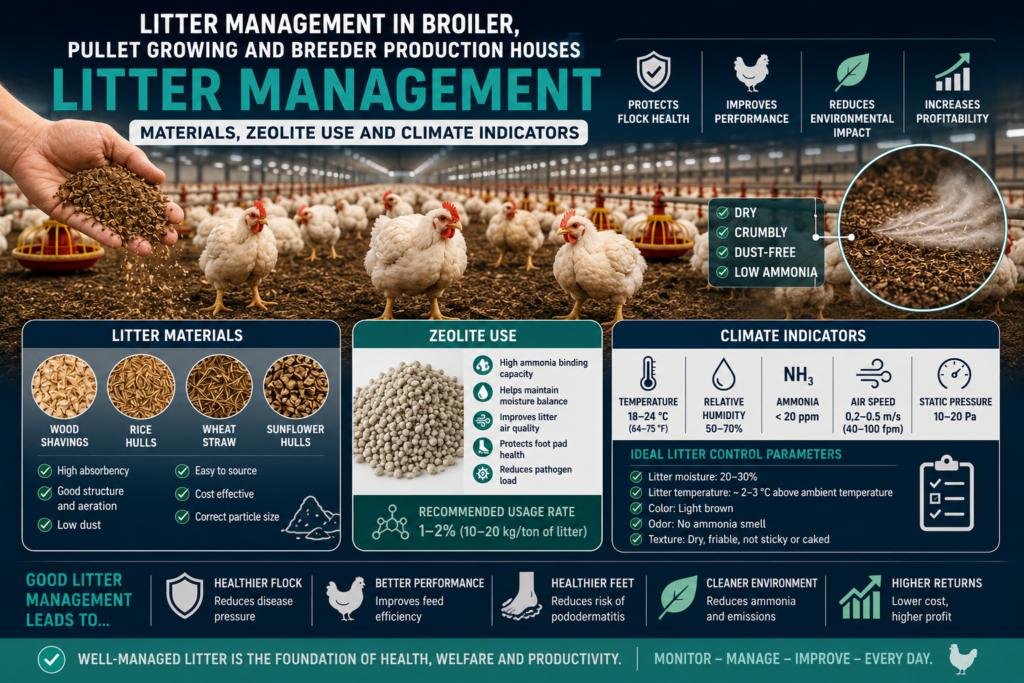
1. Litter Management Dynamics Across Production Systems
Litter management protocols cannot be executed uniformly across all poultry assets. Technical priorities shift based on the operational target:
A. Commercial Broiler Operations (Rapid Live Weight Gain)
- Focus: Managing rapid moisture accumulation caused by high stocking density and heavy feed intake during the grow-out phase.
- Critical Risk: Increased fecal volume and drinker line spillage post-week 3, driving pododermatitis and carcass downgrades at the processing plant.
B. Breeder Rearing Operations (Pullet / 0–18 Weeks)
- Focus: Controlling polydipsia (excessive water consumption). Due to feed restriction protocols (skip-a-day or daily quantitative feed allocation), birds tend to drink excess water out of hunger stress.
- Critical Risk: Intense bird activity and localized wet fecal deposits around feeding and drinking lines during feeding windows. Regular litter turning and raking are essential.
C. Breeder Production Operations (Breeding / 18–64 Weeks)
- Focus: Protecting hatching egg sanitation and maximizing mating efficiency.
- Critical Risk: Minimizing floor eggs and preventing eggshell contamination with environmental pathogens (Salmonella, E. coli). Litter depth must be maintained at an optimal level (typically 3–5 cm) to avoid encouraging floor nesting, while maintaining a dry balance between the slatted area and the litter floor.
2. Litter Substrates and Functional Additives
An optimal litter substrate must absorb moisture rapidly, release it efficiently via ventilation pathways, and buffer ammonia volatilization.
A. Primary Litter Substrates
- Pine Wood Shavings (Coarse): High absorbency due to its porous cellulosic structure. Must be dust-free and free of fungal spores (Aspergillus spp.).
- Rice Hulls: Free-flowing particle structure delays surface caking. However, during the brooding phase, chick behavior must be monitored to prevent hull ingestion.
- Chopped Straw (Wheat/Barley): Must be chopped to a length of 2–4 cm. Unchopped long straw fails to absorb moisture and forms a hard surface crust. Mycotoxin levels must be routinely screened.
- Wood Chips: Sourced strictly from resin-free softwoods, free of sharp splinters that cause mechanical skin tears.
B. Performance-Enhancing Litter Conditioners (Zeolite and Chemical Buffers)
Specialized additives used to capture moisture and chemically or physically bind ammonia gas:
- Zeolite (Clinoptilolite):
- Mechanism: A natural mineral possessing a high Cation Exchange Capacity (CEC) and a microporous crystalline structure. It traps free ammonium (NH4+) ions within its lattice structure, preventing their conversion into toxic ammonia (NH3) gas.
- Benefits: Physically adsorbs excess moisture, reduces ammonia volatilization by 40–60%, mitigates pododermatitis, and enriches the nitrogen fertilizer value of the spent litter.
- Application Rate: Broadly applied across the floor prior to placement or top-dressed during critical production weeks at 300–500 g/m².
- Sepiolite and Bentonite (Clay Minerals): Possess high water-retention capacity, rapidly trapping free moisture on the litter surface.
- Acidifying Conditioners (Aluminum Sulfate, Sodium Bisulfate): Lower litter pH below 7.0, inhibiting urease-producing bacteria and arresting ammonia synthesis.
3. What Litter Condition Reveals: Microclimate and Flock Diagnostics
Litter serves as an honest diagnostic tool, revealing environmental and physiological malfunctions within the house:
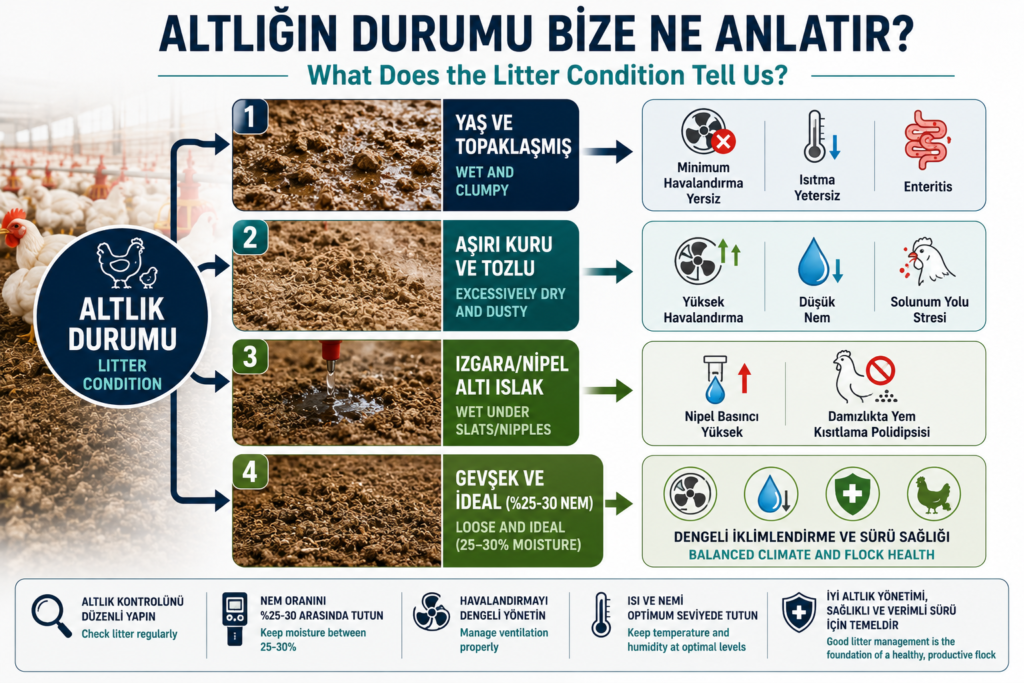
A. Wet and Caked Litter (Surface Caking):
- Deficient Minimum Ventilation: The relative humidity of the house air is saturated, preventing litter moisture from evaporating and forcing water back into the substrate.
- Inadequate Floor Heating: Cold concrete beneath the litter (<28 oC) pushes the dew point beneath the litter layer, accumulating moisture from the bottom up.
- Enteric Pathologies: Indicates wet droppings triggered by coccidiosis, necrotic enteritis (Clostridium perfringens), or high dietary sodium levels.
B. Excessively Dry and Dusty Litter:
When litter moisture drops below 20%, airborne dust levels spike, irritating the upper respiratory mucosa, exacerbating post-vaccination reactions, and predisposing the flock to colibacillosis (E. coli).
4. Optimal Litter Standards: The Squeeze Test
Target litter moisture must be maintained between 25% and 30%. The most practical field assessment is the Hand Squeeze Test:
- Optimal Litter: A handful of litter squeezed firmly forms a pliable ball that easily crumbles apart when touched or dropped. No moisture should wet the hand.
- Overly Wet Litter: Water exudes upon squeezing, or the mass remains a dense, muddy ball (moisture >35%).
- Overly Dry Litter: Fails to hold any shape and disperses like dust (moisture <20%).
5. Bioprocess Lifecycle: From Placement to Evacuation
A. House Preparation and Pre-Heating:
- Concrete floors must be thoroughly washed, disinfected, and completely dried prior to litter spreading.
- Underfloor heating must be engaged to raise concrete temperatures to a minimum of 28 oC – 30 oC.
- Litter depth should be set to 5–8 cm for broilers, 7–10 cm for breeder rearing, and 3–5 cm for breeder production houses to prevent floor egg habits.
B. In-Production Maintenance:
- In breeder rearing assets, litter around drinker lines and feeding areas should be raked daily and top-dressed with Zeolite.
- Caked areas must be removed immediately and replenished with fresh, dry material.
C. Post-Depletion Biosecurity Protocols:
- Immediately post-depletion, litter should be lightly dampened to minimize dust aerosols during cake removal and loaded directly into covered transport vehicles.
- Spent litter must be removed from the farm perimeter and routed to biogas or composting facilities.
6. Impact of Litter Quality on Health and Performance Metrics
- Footpad Dermatitis (Pododermatitis): High ammonia and moisture burn footpad tissue. In broilers, this leads to FCR losses; in breeder cocks, foot pain leads to reluctance to mate, severely depressing fertility rates.
- Hatching Egg Hygiene: In breeder production houses, damp and dirty litter drives bacterial penetration through shell pores, reducing hatchability and escalating early embryonic mortality.
- Respiratory Mucosal Damage: Ammonia concentrations exceeding 20 ppm paralyze upper respiratory ciliary activity, predisposing birds to CRD and systemic colibacillosis.
Summary and Field Recommendations
Litter management directly dictates live weight gain and carcass quality in broilers, flock uniformity in breeder rearing, and fertility rates and chick quality in breeder production. Selecting appropriate litter substrates, conditioning with ammonia-binding minerals like Zeolite, and synchronizing minimum ventilation with litter moisture dynamics remain primary determinants of enterprise profitability.
References:
- Aviagen (2020). Parent Stock Management Essentials: Litter and Nest Management in Breeder Operations.
- Miles, D. M., Owens, S. L., & Moore, P. A. (2011). Impacts of moisture, zeolites, and temperature on broiler litter ammonia emissions. Poultry Science, 90(1), 1-8.
- Cobb-Vantress (2021). Breeder Management Guide: Floor, Slat, and Litter Care Protocols.