
In modern poultry production (from commercial broiler grow-out operations to Parent Stock breeders and commercial layer complexes), water represents the largest volume nutrient consumed by birds. A broiler or commercial layer chicken consumes approximately 1.5 to 2.2 times as much water as the dry feed mass it ingests. This ratio can escalate to 3 to 4 times during ambient temperature spikes inside the house and during peak production cycles.
Despite this biological reality, field operations frequently focus on ration formulations and vaccination schedules while overlooking drinking water quality, sediment deposition inside lines, and microbial loads. However, a poor-quality, highly mineralized, or microbiologically contaminated water supply damages the intestinal mucosa, collapses the Feed Conversion Ratio (FCR), induces vaccine inactivation, and directly impairs hatching egg quality.
This article systematically evaluates drinking water quality in poultry health, globally accepted analytical parameters, the pathological impacts of mineral deficiencies and excesses, and water disinfection protocols.
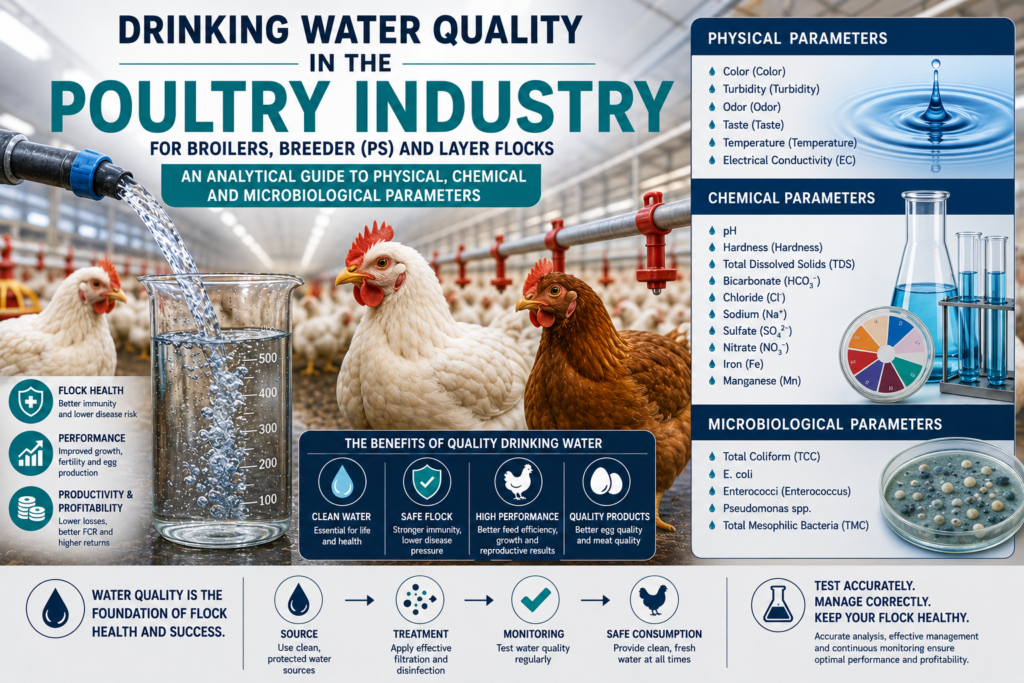
1. Physical and Chemical Parameters of Water Quality (Global Standards and Tolerance Limits)
The essential physical and chemical parameters that should be routinely analyzed in water samples drawn from house intakes or wellheads, along with their target benchmarks and pathological outcomes during deviations, are summarized below:
| Parameter | Target Ideal Value | Maximum Tolerance Limit | Consequences of Deficits / Low Levels | Consequences of Excesses / High Levels |
| pH | 6.0 – 6.8 | 5.5 – 8.0 | <5.5: Equipment and metal corrosion, nipple scaling, pepsinogen inactivation, intestinal mucosal irritation. | >8.0: Disinfectant efficiency collapses (HOCl -> ClO– conversion), ammonia toxicity escalates, feed intake drops. |
| Electrical Conductivity (EC) | <1000 µS/cm | 3000 µS/cm | — | Indicates high dissolved salt concentrations. Triggers osmotic diarrhea, wet litter, and poor FCR. |
| Total Dissolved Solids (TDS) | <1000 mg/L | 3000 mg/L | Mineral deficiency (rare). | Wet droppings, FCR degradation, renal tubular damage, and increased visceral gout cases. |
| Hardness (CaCO3) | 60 – 180 mg/L | 300 mg/L | Drops in eggshell quality, weak skeletal development. | Limescale blockages in nipples and water lines, biofilm buildup, precipitation of drugs/vaccines. |
| Sodium (Na) | <50 mg/L | 200 mg/L | Dehydration, electrolyte imbalance. | Synergizes with dietary salt to spike water intake, causing severe polydipsia and uncontrolled wet litter. |
| Chloride (Cl–) | <140 mg/L | 250 mg/L | — | Combined with elevated sodium, it increases renal load and impairs shell matrix quality in layers. |
| Sulfate (SO4-2) | <50 mg/L | 200 mg/L | — | Acts as a potent laxative when paired with magnesium or sodium, inducing acute diarrhea. |
| Iron (Fe) | <0.2 mg/L | 0.3 mg/L | — | Impairs water palatability (metallic taste), stimulating iron bacteria proliferation and line biofilm formation. |
| Manganese (Mn) | <0.05 mg/L | 0.1 mg/L | Increased risk of perosis (if unbuffered by diet). | Dark sediment deposition, nipple clogging, loss of water palatability. |
| Nitrate (NO3-N) | <10 mg/L | 25 mg/L | — | Converts to NO2, inducing methemoglobinemia; reduces blood oxygen-carrying capacity, stunting growth. |
| Nitrite (NO2-N) | 0.0 mg/L | 1.0 mg/L | Ideal status. | Direct indicator of manure or sewage contamination. Highly toxic, causing acute mortality and severe growth stunting. |
2. Microbiological Parameters and the Nipple Line Biofilm Trap
Achieving a zero-bacteria count at the storage tank intake does not guarantee that water remains clean until it reaches the bird.
A. Microbiological Tolerance Limits
- Total Coliform Bacteria: 0 CFU/100 mL (Must be zero)
- Escherichia coli (E. coli): 0 CFU/100 mL (Must be zero)
- Salmonella spp.: 0 CFU/100 mL (Zero tolerance)
- Pseudomonas aeruginosa: 0 CFU/100 mL (Critical for hatcheries and day-old chicks)
- Total Viable Count (37 oC Incubation): <100 CFU/mL
B. The Hidden Enemy in Nipple Lines: Biofilm
When flow rates inside water lines drop and water temperatures warm to around 20 oC – 25 oC, bacteria adhere to the inner surfaces of the piping.
- Biofilm Matrix Formation: Pathogens such as Pseudomonas, E. coli, and Salmonella secrete an extracellular polymeric substance (EPS) layer, weaving a sticky, mucus-like gel (biofilm) along the pipe walls.
- Resistance Shield: Bacteria encapsulated within biofilms become up to 1000 times more resistant to routine chlorine dosages or therapeutic antimicrobial treatments passing through the line.
- Vaccine and Drug Inactivation: When live vaccines (e.g., Gumboro, ND, IB) or vitamins are administered via water lines, the biofilm matrix binds and neutralizes the active viral particles, leading to widespread vaccination failure across the flock.
3. Direct Impacts of Water Quality on Production Metrics Across Industry Segments
A. Commercial Broiler Grow-Out Operations
- Feed Conversion Ratio (FCR): High pH (>8.0) or elevated TDS (>1500 mg/L) neutralizes the hydrochloric acid (HCl) required for gastric protein digestion. Undigested feed entering the intestines triggers Clostridium perfringens overgrowth, leading to Necrotic Enteritis and FCR losses of 5 to 10 points.
- Footpad Quality: High combinations of Sodium (Na) and Sulfate (SO4-2) drive chronic wet litter conditions, increasing carcass downgrades at the processing plant due to pododermatitis.
B. Breeder Parent Stock (PS) Operations
- Hatching Egg Quality: Highly hard water with imbalanced Ca/Mg ratios degrades eggshell quality in breeder hens. Eggs with compromised shell porosity undergo excessive egg weight loss during incubator setting cycles.
- Fertility and Male Performance: Enteric disorders triggered by water contamination cause vitality loss and foot lesions in cocks, directly depressing mating frequency and hatchability rates.
C. Commercial Layer Operations
- Eggshell Quality: Water containing elevated Chloride (Cl–) levels inhibits carbonic anhydrase enzyme activity in the shell gland (uterus), resulting in shell thinning, increased cracked egg percentages, and commercial losses.
- Production Persistence: Contaminated water accelerates early drops from peak lay performance and undermines flock uniformity.
4. Water Disinfection and Conditioning Protocols
Securing water hygiene at the house level requires a combined bioprocess approach rather than a single intervention:
- pH Adjustment (Acidification): Water pH should be adjusted to 6.0 – 6.5 using organic acid blends (Formic, Propionic, and Acetic acid combinations) prior to chlorination. A lower pH inhibits pathogen proliferation in the gut and boosts the germicidal power of chlorine.
- Chlorination (Free Chlorine Management):
- The core metric to evaluate is not “Total Chlorine,” but rather “Free Chlorine” measured directly at the far end of the nipple line.
- Free chlorine at the nipple tip should be locked between 2.0 – 4.0 ppm.
- In water with a pH > 8.0, chlorine gas converts into inactive hypochlorite (ClO–) ions, losing its sanitizing power. Thus, acidification and chlorination must be executed simultaneously.
- Alternative Disinfectants: In water systems with heavy organic loading where chlorine falls short, Chlorine Dioxide (ClO2) or Hydrogen Peroxide (H2O2) should be deployed. Chlorine dioxide operates independently of pH and possesses superior biofilm-stripping capabilities.
- Inter-Flock Line Sanitation (Flushing): Immediately post-depletion, water lines should be dosed with a 2% – 3% Hydrogen Peroxide solution, left to dwell for 24 hours, and thoroughly backflushed using high-pressure water loops.
Summary and Field Recommendations
Drinking water is not merely a utility input in poultry operations; it is the primary biological driver managing flock performance. Comprehensive chemical and microbiological water analyses should be performed at least twice annually (at the start of summer and winter cycles), alongside weekly monitoring of free chlorine and pH at terminal nipple outlets. An integration that optimizes its water quality improves feed conversion, reduces medication costs, and fully unlocks the genetic potential of the flock in the field.
References:
- Fairchild, B. D., & Ritz, C. W. (2012). Poultry Drinking Water Primer. University of Georgia Cooperative Extension Bulletin 1301.
- Aviagen (2019). Ross Broiler Management Manual: Water Quality Standards and Line Sanitation.
- Tabler, G. T., et al. (2013). Water Intake: A Sensitive Broiler Management Tool. University of Arkansas Cooperative Extension Service.