
Veterinary surgeons, technical managers, and field specialists working in the poultry sector frequently encounter two primary codes on flock documentation and parent stock technical manuals for Ross 308 chicks: SF (Slow Feathering) and FF (Fast Feathering).
What appears on the surface as a simple variation in feather growth speed is, in reality, a brilliant genetic engineering solution designed to reduce hatchery labor costs and enable sex-separate feeding and management strategies in commercial broiler production.
What exactly do the SF and FF designations mean within the Ross 308 genetic program, how does the underlying biological mechanism function, and what are the practical implications for field management?
1. The Fundamental Question: Why Do SF and FF Genotypes Exist?
Vent sexing (the traditional Japanese method) of hundreds of thousands of day-old commercial broiler chicks in modern hatcheries is labor-intensive, requires highly specialized personnel, introduces mechanical handling stress to day-old chicks, and slows throughput.
To eliminate these operational bottlenecks, geneticists introduced sex-linked feathering genes. The primary objective is to allow hatchery staff to determine a chick’s sex within seconds simply by examining the wing feather structure.
2. How Does the Genetic Mechanism Function?
Feathering rate is governed by a sex-linked locus carried on the Z chromosome:
- Dominant K allele: Induces Slow Feathering (SF).
- Recessive k+ allele: Induces Fast Feathering (FF).
To deploy this mechanism effectively at the commercial level, primary breeding programs configure the Parent Stock (PS) cross as follows:
- Parent Stock Female (Hen): Possesses the SF (K) genotype (Slow Feathering).
- Parent Stock Male (Rooster): Possesses the FF (k+) genotype (Fast Feathering).
When this cross is produced, the inheritance pattern in the resulting commercial broiler offspring flips:
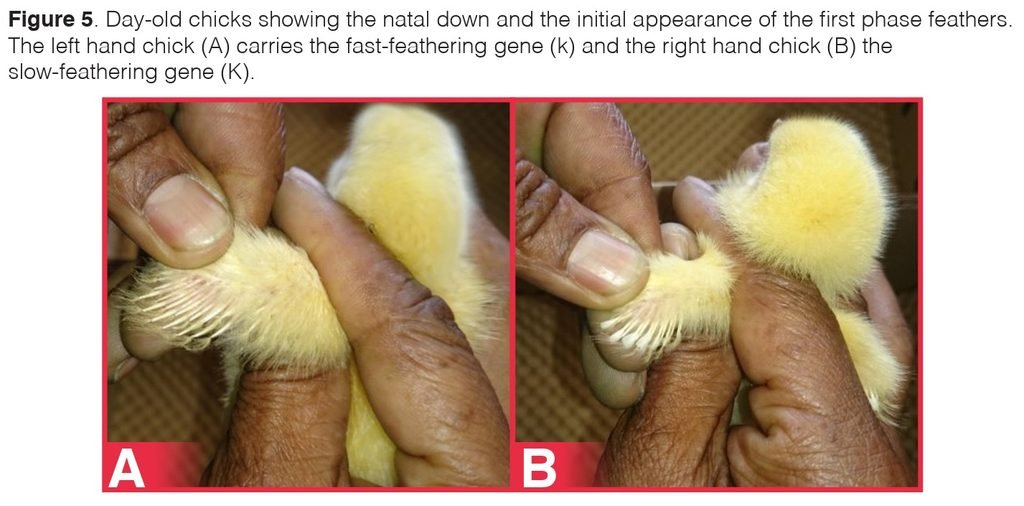
- Female Broiler Chicks: Inherit the recessive fast-feathering allele (k+) from the male parent. They hatch as Fast Feathering (FF).
- Male Broiler Chicks: Inherit the dominant slow-feathering allele (K) from the female parent. They hatch as Slow Feathering (SF).
3. Visual Identification in the Hatchery
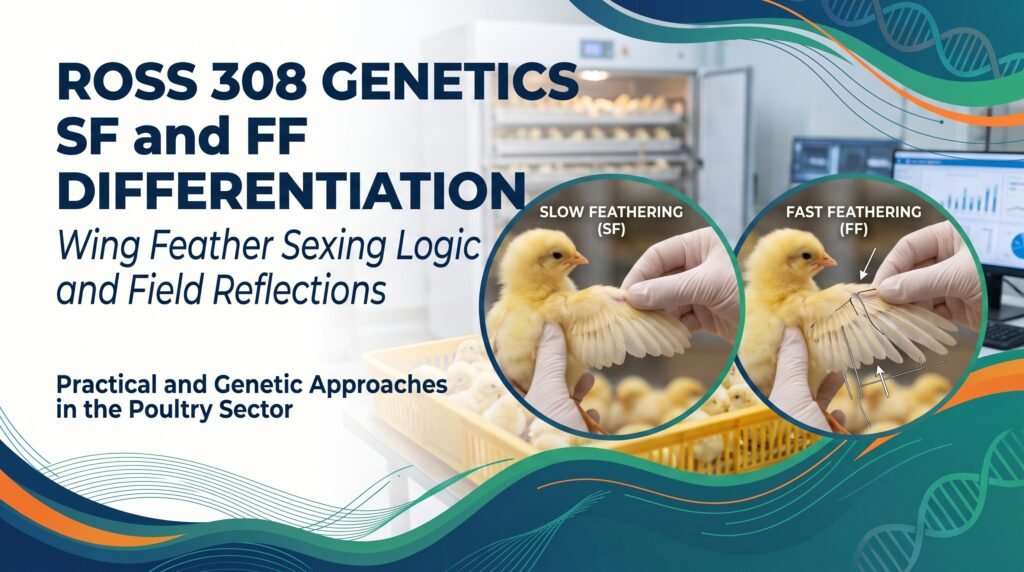
When day-old chicks pass through the hatchery sorting lines, staff spread the wing tip to inspect the primary and covert feathers:
- Female Broiler Chick (FF): Primary remiges are distinctly longer than the overlapping covert feathers.
- Male Broiler Chick (SF): Primary remiges and coverts are equal in length, or coverts extend beyond the primaries.
This identification process enables commercial integrations to separate male and female chicks with near-100% accuracy, placing them into dedicated houses to execute Sex-Separate Feeding strategies tailored to the distinct nutritional profiles and growth trajectories of males and females.
4. Field Management and Biological Implications
The SF/FF designation impacts flock physiological management and environmental control throughout rearing and production:
- Brooding Temperature & Thermoregulation: Slow-feathering male chicks (SF) exhibit reduced feather cover over the dorsal region during the first 2–3 weeks of age. Because plumage serves as thermal insulation, unfeathered skin increases radiative and convective body heat loss. Consequently, brooding temperatures in male houses during cold weather conditions may need to be maintained 0.5 oC – 1.0 oC higher relative to female houses.
- Heat Stress & Wind-Chill Tolerance: While delayed dorsal feathering increases heat loss in cold environments, it offers a distinct advantage during summer heat stress in tunnel-ventilated houses. Direct air velocity (wind-chill effect) reaches the exposed skin of males more effectively, allowing better convective heat dissipation compared to fully feathered females.
- Juvenile Molt & Dorsal Scratches: Research demonstrates that the slow-feathering (K) genotype experiences delayed feather development not only at hatch, but also during juvenile molting phases (weeks 6–10). Prolonged exposure of the dorsal tract increases susceptibility to skin scratches (dermatitis) under high stocking densities or feeder competition, requiring careful management of litter quality and light intensity.
- Breeder Female Feather Cover and Fertility: Technical studies by Aviagen (Fisher, 2016) emphasize that maintaining dorsal feather cover in Parent Stock females is critical for protecting the skin from male claws and spurs during mating. Loss of dorsal plumage induces mating reluctance in hens, leading to a decline in mating frequency and subsequent losses in late-stage flock fertility and chick production.
Summary
The SF and FF differentiation in Ross 308 genetics represents a strategic tool optimizing operations from the hatchery to the processing plant. Deploying SF Parent Stock females provides the genetic foundation for feather sexing at hatch, enabling precise sex-separate feeding, tailored brooding temperatures, and optimized growth performance across both male and female commercial broilers.
References:
- Fisher, C. (2016). Feathering in Broiler Breeder Females. Aviagen Technical Publication.
- Aviagen (2022). Ross 308 & Ross 308 FF Broiler Performance Objectives and Management Manual.
- Leeson, S., & Summers, J. D. (2008). Broiler Breeder Production. University Books.