
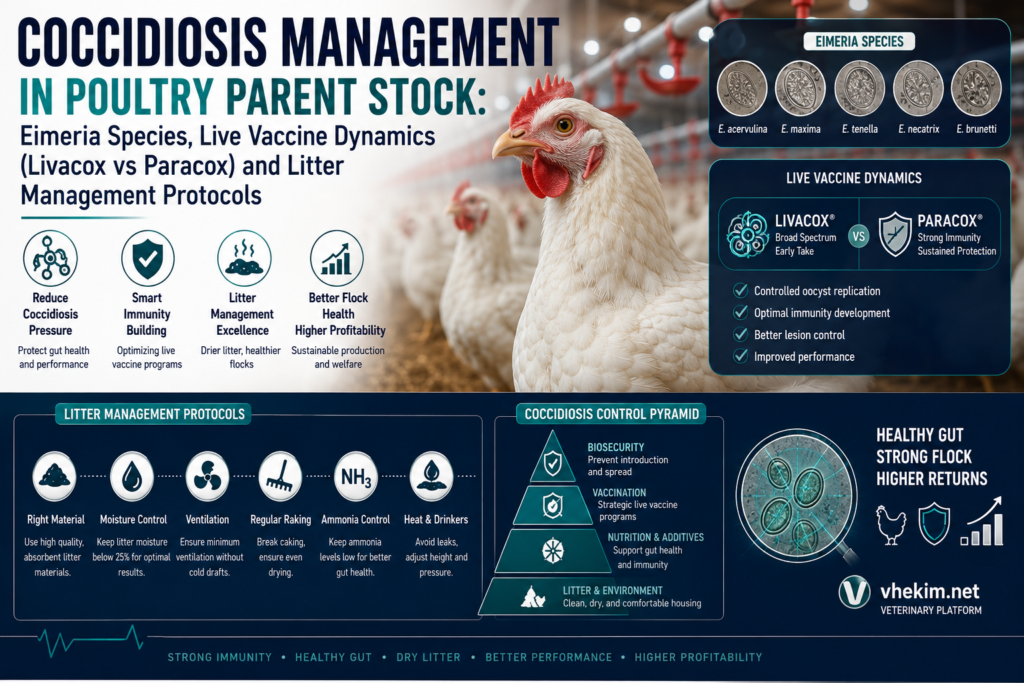
Coccidiosis management in Parent Stock (PS) breeders differs radically from commercial broiler operations. While broiler production relies on continuous dietary anticoccidials (coccidiostats/coccidicides) to suppress parasite replication until slaughter, breeder management aims to induce a controlled infection cycle during the first weeks of life to build lifelong cell-mediated immunity.
This immunological management is driven by live vaccines administered at day 0 in the hatchery (Livacox, Paracox, Coccivac, etc.) combined with strict house-level litter and humidity control. This guide evaluates the predominant Eimeria species in breeders, live vaccine biokinetics, commercial vaccine variations, anticoccidial withdrawal windows, and the vital necessity of litter recycling during brooding expansion.
1. The 5 Major Eimeria Species in Breeders and Their Pathologies
Avian coccidiosis is caused by protozoan parasites of the genus Eimeria. There is no cross-immunity between species; immunity developed against E. acervulina offers zero protection against E. tenella.
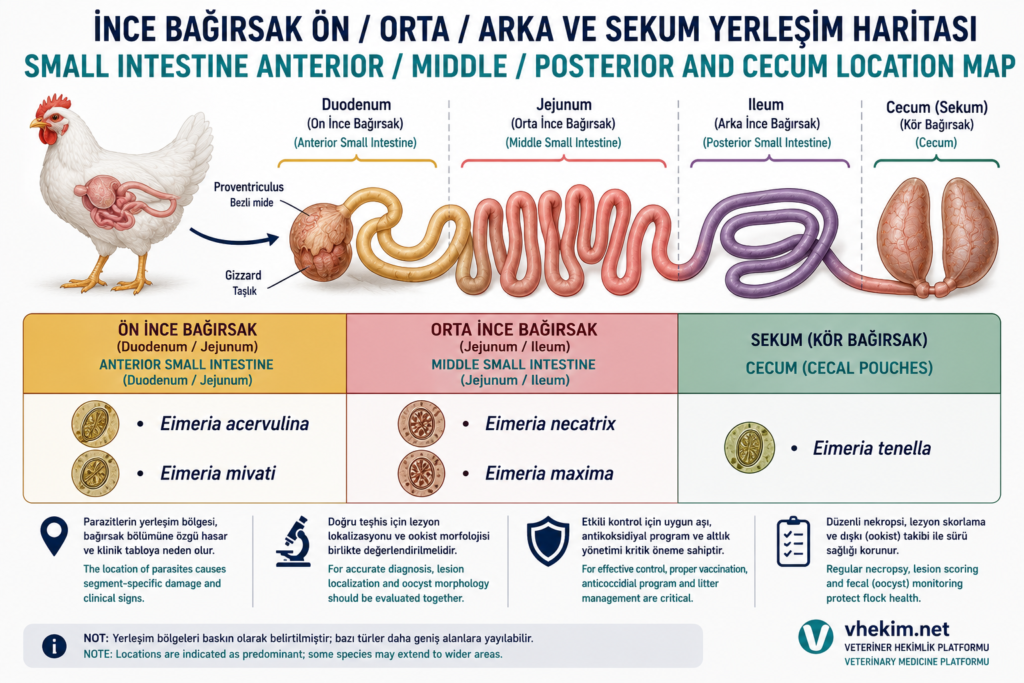
- Eimeria tenella (Cecal Coccidiosis):
- Localization: Ceca (cecal pouches).
- Pathology & Symptoms: Highly pathogenic. Induces severe cecal hemorrhage, mucosal necrosis, and clotted blood/bloody droppings within the cecal cores. Causes acute mass mortality.
- Eimeria necatrix (Acute Intestinal Coccidiosis):
- Localization: Mid-gut (Jejunum).
- Pathology & Symptoms: The greatest parasitic threat during breeder rearing (weeks 8–18). Induces severe ballooning of the intestine, white spots resembling sprinkled salt combined with red petechial hemorrhages visible from the serosal surface. The intestinal lumen becomes engorged with blood and fluid.
- Eimeria maxima (Subclinical/Mucoid Enteritis & FCR Losses):
- Localization: Mid-intestinal tract.
- Pathology & Symptoms: Induces excessive orange/pink mucinous exudate, mucosal thickening, and severe feed passage (undigested feed in droppings), serving as the primary trigger for Necrotic Enteritis (Clostridium perfringens).
- Eimeria acervulina:
- Localization: Duodenum.
- Pathology & Symptoms: Characterized by transverse white ladder-like striations along the duodenal mucosa. Causes severe malabsorption and weight gain depression.
- Eimeria mivati (or E. brunetti):
- Localization: Lower intestine extending to the rectum and cloaca.
- Pathology & Symptoms: Induces extensive epithelial sloughing, watery diarrhea, and flock uniformity loss.
2. Day 0 Hatchery Vaccination Dynamics and Vaccine Types
Day-old breeder chicks are vaccinated in the hatchery via coarse spray or gel droplets using live attenuated or non-attenuated vaccines (e.g., Livacox T, Livacox Q, Paracox-5, Paracox-8, Coccivac-B).
A. Attenuated vs. Non-Attenuated Vaccines
- Attenuated Vaccines (e.g., Livacox, Paracox): Sporozoites have been selected in the laboratory for shortened prepatent times (precocious lines). They complete fewer schizogonic cycles, causing minimal mucosal damage while stimulating robust cell-mediated immunity.
- Non-Attenuated Vaccines (e.g., Coccivac): Contain low doses of wild-type strains. They cause more pronounced mucosal lesions, requiring exceptionally strict litter moisture management.
B. Expected Post-Vaccination Reactions (What to Observe)
A mild vaccine reaction is expected between days 14 and 28 post-vaccination:
- Normal Clinical Picture: Slight softening of droppings, occasional orange mucoid threads, and transient pauses in feed consumption.
- Critical Threshold: Fresh blood in droppings, severe watery diarrhea, mucoid enteritis, or daily mortality exceeding 0.1% indicates a vaccine breakdown or secondary Clostridium breakdown requiring clinical intervention.
3. Commercial Vaccine Breakdown: Livacox vs. Paracox
Field practitioners frequently evaluate two primary commercial vaccine ranges: Livacox (Bioveta) and Paracox (MSD Animal Health). Differences focus on species count, attenuation technology, and target flock spectrums.
A. Species and Strain Comparison Table
| Parameter | Livacox T | Livacox Q | Paracox-5 | Paracox-8 |
| Target Flock | Broilers | Breeders (PS) & Layers | Broilers | Breeders (PS) & Layers |
| Species Count | 3 Species (4 Strains) | 4 Species (5 Strains) | 5 Species | 7 Species (8 Strains) |
| Included Eimeria Species | E. acervulina, E. tenella, E. maxima (2 strains) | E. acervulina, E. tenella, E. maxima (2 strains), E. necatrix | E. acervulina, E. tenella, E. maxima (2 strains), E. mitis | E. acervulina, E. tenella, E. maxima (2 strains), E. necatrix, E. brunetti, E. mitis, E. praecox |
| Attenuation Method | Selection for precociousness | Selection for precociousness | Selection for precociousness | Selection for precociousness |
B. The “Competitive Exclusion” Principle and Immunological Gaps
Receptor binding sites on intestinal epithelial cells are finite. The biological principle states: “First come, first served.”
- Occupation by Attenuated Strains: When vaccine strains colonize epithelial cells early, they occupy binding sites and competitively exclude wild-type pathogenic Eimeria oocysts from penetrating the tissue.
- The Immunological Gap (Absence of Cross-Immunity): Because there is NO CROSS-IMMUNITY between Eimeria species, using a 3-species vaccine (e.g., broiler formulations) in breeders leaves open immunological gaps. If a field strain not present in the vaccine (such as E. necatrix) enters the house, no memory T-cells exist to neutralize it.
- Outcome: The flock remains protected against species A, B, and C, but wild species D (E. necatrix) colonizes unblocked receptors, triggering hemorrhagic outbreaks between weeks 10 and 14. Therefore, broad-spectrum vaccines containing E. necatrix are mandatory for breeders.
C. Selection Rationale: Livacox vs. Paracox
1. Rationale for Livacox (Livacox Q)
- Lower Vaccine Stress: Livacox strains are highly attenuated to limit schizogony, reducing post-vaccination enteritis and litter degradation between days 14 and 21.
- Ease of Administration: Highly stable in spray and gel carriers, facilitating uniform intake via preening.
- Cost-Benefit Ratio: Provides an economical option for PS breeders when historical field challenges are free from E. brunetti or E. mitis.
2. Rationale for Paracox (Paracox-8)
- Complete 8-Strain Coverage: Covers all 7 major avian Eimeria species across 8 distinct strains, protecting against secondary species like E. brunetti and E. mitis.
- Maximum Protection in High-Risk Sites: Recommended for breeder facilities with a history of acute field coccidiosis or Necrotic Enteritis outbreaks.
💡 Breeder Rule: Broiler-grade 3-species vaccines (Livacox T, Paracox-5) MUST NEVER BE USED IN BREEDERS, as they lack Eimeria necatrix. Breeder operations must always deploy Livacox Q or Paracox-8.
4. Anticoccidial Restrictions: Why and When Are They Withheld?
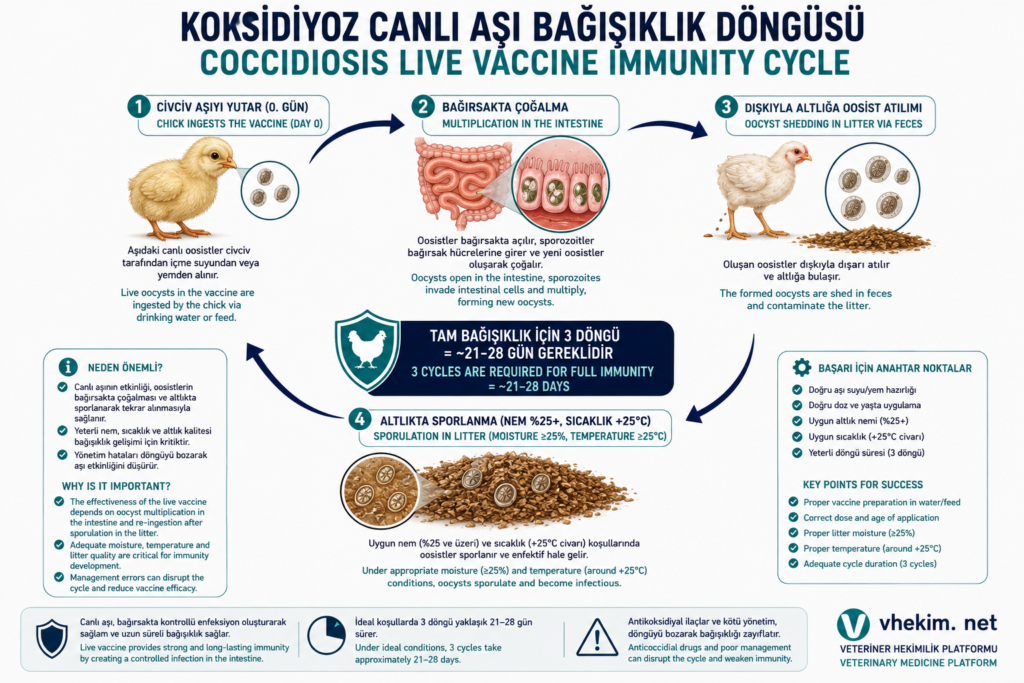
Live coccidiosis vaccines rely on cycling: oocysts replicate in the gut, shed into the litter, sporulate under ambient moisture/heat, and are re-ingested by chicks ($re-infection\ cycle$). Achieving complete immunity requires at least 3 consecutive cycles.
A. Why Anticoccidials Must Be Withheld
Including ionophores or synthetic anticoccidials (Salinomycin, Monensin, Lasalocid, Diclazuril, etc.) in feed or water kills the attenuated vaccine oocysts during initial replication. The cycling chain breaks, leaving the flock immunologically naive.
B. Withdrawal Window
- Anticoccidials must be withheld from vaccinated breeders for at least 14 to 21 days (preferably up to 28 days post-vaccination).
- Emergency Interventions: If a severe wild-type outbreak occurs, short pulse treatments with amprolium or specific sulfonamides may be administered under veterinary supervision. However, this dampens vaccine-induced immunity.
5. Litter, Moisture, Brooding Ring Expansion, and Litter Recycling
Vaccine performance depends heavily on the microclimate of the poultry litter.
A. Litter Parameters for Optimal Oocyst Sporulation
Shed oocysts require three environmental conditions to sporulate and become infective: Temperature (25 oC – 30 oC), Oxygen, and Litter Moisture (%25 – %35).
- Litter Too Dry (<%20 Moisture): Oocysts fail to sporulate and die. Cycling stops, leaving birds susceptible to wild field strains after day 35.
- Litter Too Wet (>%45 Moisture): Oocyst sporulation spikes uncontrollably. Birds ingest excessive infective oocysts, converting a controlled vaccination process into clinical disease.
B. The Golden Rule of Brooding Ring Expansion
Breeder chicks are initially brooding in restricted rings or partial house compartments, which are expanded progressively as birds grow.
🚫 Mandatory Litter Recycling Rule:
When expanding brooding rings or moving chicks to new house sections, used litter containing sporulated vaccine oocysts MUST be moved and mixed into the newly opened fresh litter area!
Why Must Used Litter Be Transferred?
Moving birds onto fresh, sterile litter while leaving used litter behind causes two major issues:
- Chicks lose access to sporulated oocysts, breaking the re-infection cycle and stalling immunity development.
- Because fresh litter contains zero sporulated vaccine oocysts, birds expanding into the new area become immunologically naive compared to those remaining on used litter, destroying flock immune uniformity.
6. Operational Field Management Check-List
- Days 0 – 3: Verify spray/gel application coverage in the hatchery (dye indicators on down feathers). Maintain initial brooding litter moisture between %28 and %30.
- Days 7 – 10: First oocyst shedding and sporulation phase. Turn top litter layers to maintain aeration and prevent caking.
- Days 14 – 21 (Critical Window): Second and third re-infection cycles. During brooding ring expansion, spread used litter evenly across the newly opened fresh litter areas. Perform lesion scoring and fecal checks.
- Day 28: Oocysts Per Gram (OPG) counts and immunity verification. The flock should now possess solid protective immunity against field challenges.
Summary and Recommendations
Coccidiosis vaccination in Parent Stock breeders extends beyond hatchery administration; it is a dynamic biological process managed through litter moisture and litter recycling in the house. Withholding anticoccidials, keeping litter moisture between %25 and %35, and transferring used litter during ring expansions ensures flock protection throughout the 60-week breeding cycle.
References:
- Chapman, H. D. (2014). Milestones in coccidiosis research and immunization of poultry. Poultry Science, 93(3), 501-511.
- Aviagen (2020). Ross 308 Parent Stock Management Handbook: Coccidiosis Control and Live Vaccine Management.
- Cobb-Vantress (2021). Cobb Breeder Management Guide: Litter Management and Coccidiosis Vaccination Protocols.
- Shirley, M. W., & Bedrník, P. (1997). Live attenuated vaccines against avian coccidiosis. International Journal for Parasitology, 27(10), 1163-1170.