
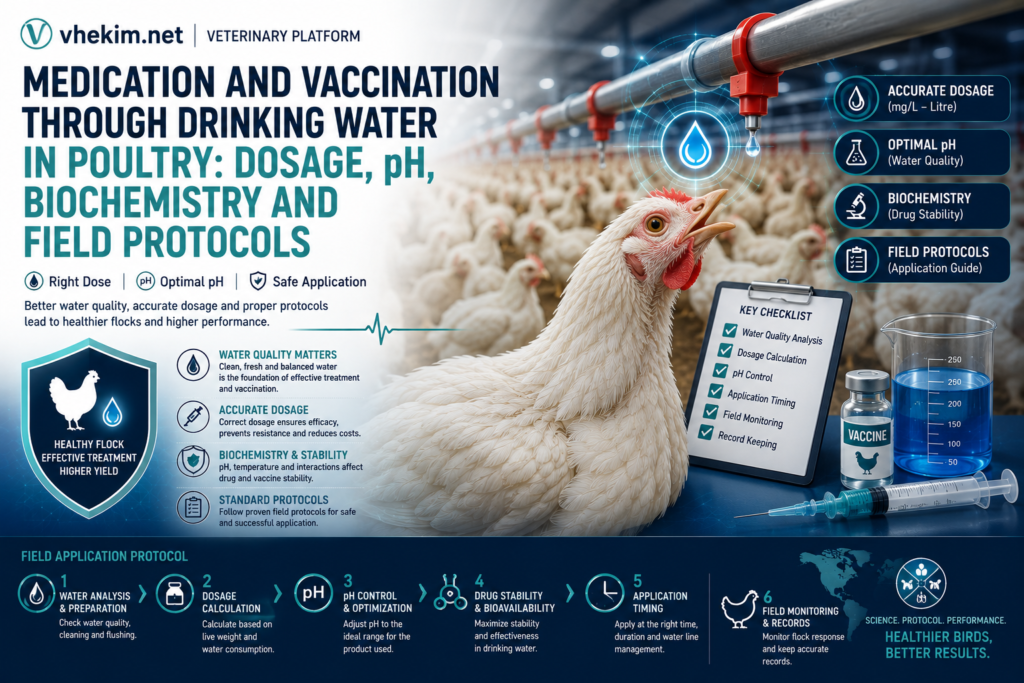
In commercial broiler, Parent Stock (PS) breeder, and commercial layer operations, drinking water serves not merely as a vital physiological input, but as the primary biological vector for delivering therapeutic agents (antibiotics, antiparasitics, vitamins/minerals, organic acids) and immunological protection (live attenuated vaccines).
However, water application involves far more than simply dissolving a product into a header tank. Water pH, hardness, dissolved oxygen, free chlorine levels, static pressure at nipple outlets, and the presence of microbial biofilm matrices inside pipework determine whether a treatment succeeds or a live vaccine undergoes complete inactivation.
This guide evaluates the pharmacokinetic dynamics, biochemical mechanisms, and field operational protocols required for drinking water medication and vaccination.
1. Water Intake Physiology and Dosage Engineering
A common technical error in field medication is calculating treatments based on volumetric ratios (e.g., “X grams per 1,000 liters of water”). The clinically accurate approach requires dosing based on Active Ingredient per Unit of Live Weight (mg/kg BW).
A. Dynamic Water Consumption Ratios
Under thermoneutral conditions (18 – 22 oC), poultry consume approximately 1.8 to 2.2 times their dry feed intake in water.
Daily Water Intake (Liters) ≈ Daily Feed Consumption (kg) x (1.8 to 2.2)
When ambient temperatures exceed 30 oC, evaporative cooling via panting causes water-to-feed ratios to surge to 3.0 to 4.0 times baseline. Volumetric dosing under these conditions induces severe accidental overdosing and systemic toxicity.
B. Proportional Medicators (Dosatron / Hydroblend) and Stock Solution Calculations
In modern facilities, products are administered using proportional inline medicators rather than header tanks to prevent precipitation and biofilm proliferation.
Stock Solution Formula:
- Flock Population (N): 20,000 broilers
- Average Live Weight (BW): 1.8 kg (Total Biomass = 36,000 kg)
- Prescribed Dosage (D): 20 mg Active Ingredient / kg BW / day
- Product Concentration (C): 50% powder (1 g product = 500 mg active ingredient)
- Proportional Doser Rate (R): 1% (1:100 setting)
Total Active Ingredient Required (mg) = 36,000 kg x 20 mg/kg = 720,000 mg (720 g Active Ingredient)
Commercial Product Mass Required = 720 g / 0.50 = 1,440 g (1.44 kg Product)
Stock Solution Volume:
If total daily house water consumption equals 5,000 L and the doser is calibrated to 1% (1:100), the pump draws 1 L of stock solution for every 100 L of main line flow.
Stock Solution Bucket Volume = 5,000 L x 0.01 = 50 Liters Water
1.44 kg of commercial product is fully dissolved in 50 L of clean water to form the stock solution.
🧮 Technical Tool & Field Application:
To automatically calculate exact commercial product quantities and stock solution dosages for proportional pumps (Dosatron) based on flock live weight, bird count, daily water intake, and prescribed active ingredient dose (mg/kg BW), deploy our Poultry Medication and Vaccine Dosage Calculator.
2. Water Chemistry and Drug Solubility Dynamics
A. pH and the Henderson-Hasselbalch Equilibrium
To prevent precipitation and nipple blockages, the water pH must align with the drug’s $pKa$ value.
| Active Pharmaceutical Ingredient | Chemical Character | pKa Value | Target Water pH Range | Physicochemical Reaction at Suboptimal pH |
| Amoxicillin / Ampicillin | Weak Acid | ~ 7.4 | 7.0 – 8.0 (Slightly Alkaline) | Rapidly crystallizes and precipitates at low pH (<6.0), clogging nipple valves. |
| Doxycycline / Oxytetracycline | Weak Base / Amphoteric | ~ 3.3 / 7.5 | 4.0 – 5.5 (Acidic) | Forms insoluble brown chelate complexes with Ca+2 and Mg+2 at alkaline pH (>7.0). |
| Enrofloxacin / Ciprofloxacin | Amphoteric | ~ 6.0 / 8.8 | 6.5 – 7.5 (Neutral) | Solubility drops sharply at extreme acidic or alkaline levels; crystallizes at the isoelectric point. |
| Sulfonamides (Sulfadimidine) | Weak Acid | ~ 7.5 | 7.5 – 8.5 (Alkaline) | Precipitates in acidic water; increases the risk of renal tubular crystalluria. |
| Tylosin / Tilmicosin | Weak Base | ~ 7.1 | 5.5 – 6.5 (Slightly Acidic) | Solubility declines in alkaline water, reducing oral bioavailability. |
⚠️ Field Rule: When administering Amoxicillin or Sulfonamides, organic acid injection systems must be shut off and lines thoroughly flushed. Acidic water causes immediate inline drug precipitation and severe therapeutic underdosing.
B. Water Hardness and Cation Chelation
Elevated concentrations of Calcium (Ca+2), Magnesium (Mg+2), and Iron (Fe+2 / Fe+3) ions react with Tetracyclines and Fluoroquinolones (Enrofloxacin), forming insoluble, non-absorbable chelate complexes.
Tetracycline + Ca+2 ⟶ [Tetracycline-Ca]+2 ↓ (Zero Bioavailability Precipitate)
In well water exceeding 200 mg/L CaCO3 hardness, water softeners or approved sequestering agents must be deployed prior to administering tetracyclines.
3. Live Water Vaccination Protocols
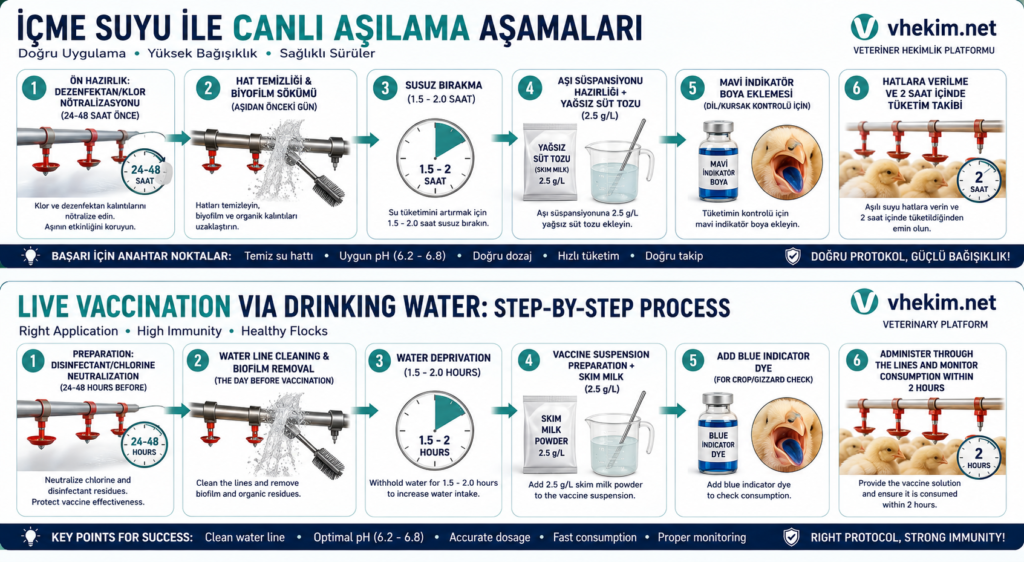
Live attenuated viral vaccines (Infectious Bronchitis – IB, Newcastle Disease – ND, Infectious Bursal Disease – IBD/Gumboro, Avian Encephalomyelitis – AE, Tenosynovitis) contain live viral particles highly susceptible to environmental degradation.
A. Pre-Vaccination Water Deprivation
To ensure rapid, uniform consumption across the entire flock, water must be temporarily restricted based on ambient house temperatures:
- <20 oC House Temperature: 2 Hours Deprivation
- 20 – 25 oC House Temperature: 1.5 Hours Deprivation
- >25 oC House Temperature: 1 Hour Deprivation (Do not exceed 2 hour at high temperatures; acute dehydration triggers gut mucosal stress and impairs viral antigen presentation).
B. Vaccine Stabilizers
Residual free chlorine (>0.2 ppm) or heavy metal ions in water lines destroy live viral particles within seconds.
- Skimmed Milk Powder: Added at 2.0 – 2.5 grams/liter. Casein proteins bind free chlorine and heavy metals, forming a protective organic buffer around viral particles.
- Commercial Synthetic Stabilizers (Cevamune, Vacc-Safe, etc.): Neutralize chlorine rapidly and buffer water pH to a neutral range (6.5 – 7.5) favorable for viral survival.
🚫 Critical Rule: Never administer chlorine, chlorine dioxide, hydrogen peroxide, organic acids, or antibiotics 48 hours prior to and 24 hours after live vaccination.
C. Vaccine Take Score Audit
Using blue dye or indicator-stabilized solutions, audit 100 birds caught randomly from 5 distinct house zones 1 hour post-vaccination:
Vaccine Take Success Rate (%) = (Number of Birds with Blue Tongue-Crop/100) x 100
- %95 – %100 Staining: Excellent vaccination execution.
- %85 – %94 Staining: Acceptable threshold.
- <%85 Staining: Vaccination Failure! Indicates improper deprivation timing, insufficient nipple flow rates, or un-primed line ends.
4. Pharmacodynamic Dynamics: Pulse Dosing vs. Continuous Dosing
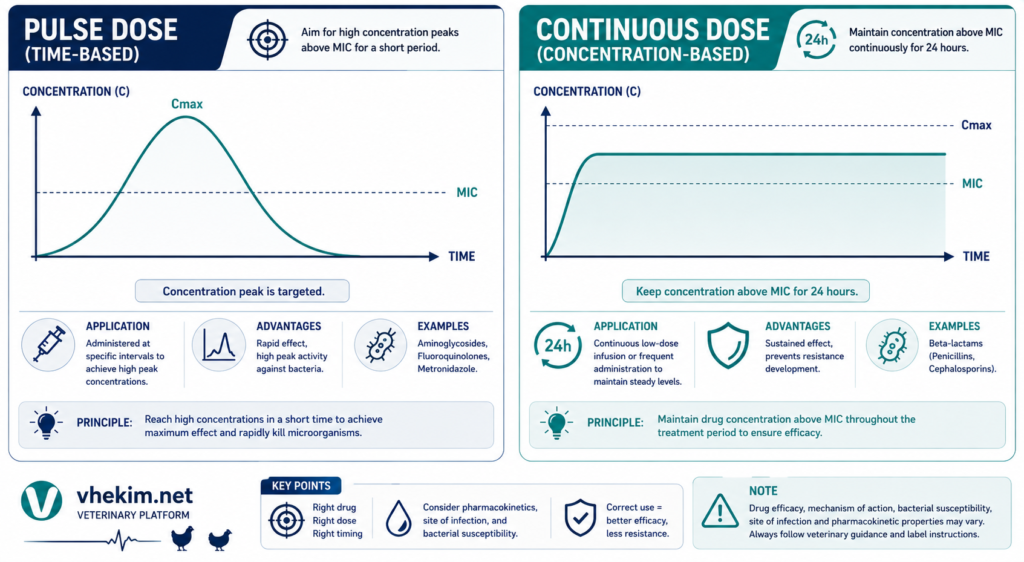
A. Concentration-Dependent Antimicrobials (Pulse Dosing)
- Examples: Fluoroquinolones (Enrofloxacin), Aminoglycosides (Neomycin, Gentamicin).
- Mechanism: Bactericidal. Requires achieving a high peak plasma concentration relative to MIC (Cmax / MIC ≥ 10 – 12).
- Field Protocol: The total calculated daily dose is dissolved into a volume consumed within 3 to 4 hours, followed by clean water.
B. Time-Dependent Antimicrobials (Continuous Dosing)
- Examples: Amoxicillin, Tetracyclines, Tylosin, Sulfonamides.
- Mechanism: Bacteriostatic or time-dependent bactericidal. Tissue concentrations must remain above MIC (T > MIC) for at least 50% – 70% of the 24-hour treatment cycle.
- Field Protocol: The daily dose is distributed continuously across 12 to 24 hours of water intake.
5. Field Operational Check-List
- D -2 Days (Pre-Application):
- High-pressure line flushing (3 – 4 bar) to strip organic biofilm.
- Deactivate inline chlorinators and acid injection systems.
- D -0 Day (Application):
- Sanitize stock solution containers.
- Verify water temperature (15 – 20 oC target; cool with ice packs if >22 oC).
- Calibrate proportional medicator setting (1:100 or 1:50).
- Prime water lines by opening terminal drain valves until blue-dyed solution reaches the far end of every line.
- D +1 Day (Post-Application):
- Flush water lines with an organic acid solution to remove carrier residues (dextrose/lactose) that promote microbial regrowth.
- Audit Vaccine Take percentages and log records.
6. Frequently Asked Questions
Q: Can I use hot water to improve drug solubility?
A: No. Temperatures exceeding 40 oC destroy the beta-lactam ring in penicillin-derived antibiotics (e.g., Amoxicillin) and kill live attenuated vaccine viruses. Water must remain at ambient temperatures (18 – 22 oC).
Q: Can I mix vitamins and antibiotics in the same stock solution bucket?
A: This is not recommended. B-complex vitamins or carbohydrate carriers (dextrose/lactose) can bind antibiotic molecules, causing precipitation and fueling rapid bacterial biofilm growth inside distribution lines.
Summary and Field Recommendations
Water-administered therapeutics and live vaccines require careful control of water chemistry and engineering parameters. Unbuffered $pH$, high mineral hardness, un-primed terminal lines, or elevated line temperatures can render treatments ineffective. Water supplies should undergo full physicochemical analysis at least twice annually, drug $pKa$ compatibility with water $pH$ must be verified prior to treatment, and chlorine neutralization protocols must be enforced during live viral vaccination.
References:
- Riviere, J. E., & Papich, M. G. (Eds.). (2018). Veterinary Pharmacology and Therapeutics (10th ed.). Wiley-Blackwell.
- Aviagen (2020). Ross 308 Broiler Management Handbook: Water Quality, Medication, and Vaccination Protocols. Aviagen Technical Library.
- Cobb-Vantress (2021). Cobb Breeder & Broiler Management Guide: Drinking Water Vaccination and Sanitation. Cobb-Vantress Technical Guidelines.
- Fairchild, B. D., & Ritz, C. W. (2012). Poultry Drinking Water Primer. University of Georgia Cooperative Extension Bulletin 1301.