
In modern industrial poultry production, the physical form in which a ration is presented to the flock dictates biological performance just as much as its nutritional specs. Processing operations conducted at the feed-mill alter the physicochemical structure of raw materials, thereby establishing the trajectory for overall digestibility, flock uniformity, and operating profitability (FCR).
Three primary feed forms are utilized in poultry nutrition: Mash, Pellet, and Crumble.
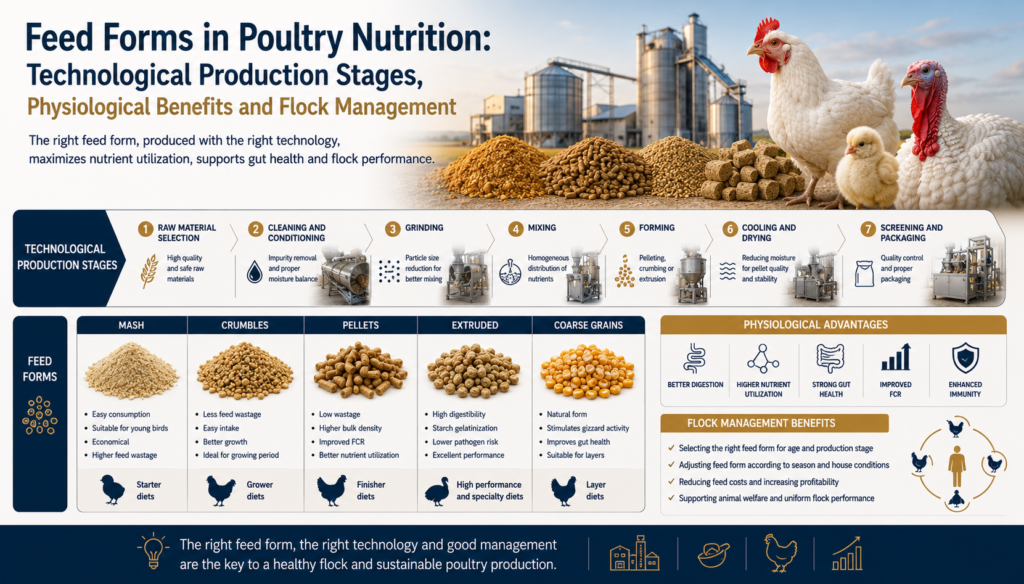
1. MASH FEED
Mash feed is the raw form of feed obtained by simply grinding raw materials in a hammer mill and blending them homogeneously with micro and macro components, without undergoing any thermal or hydrothermal processing.
- Target Flocks: Primarily preferred for commercial egg layers, specific rearing phases of broiler breeders, and certain exceptional starter phases in turkeys or broilers. In commercial layers, maintaining a coarse particle size for calcium (Ca) sources (via coarse limestone) is absolutely non-negotiable for eggshell quality and medullary bone replenishment.
Advantages:
- Production Cost (OPEX): Because it bypasses the steam conditioning and extrusion stages at the mill, mash has the lowest manufacturing cost per ton.
- Gizzard Development: Coarsely ground mash feed mechanically stimulates the gizzard—the anatomical mill of the avian digestive tract. This increased muscular workload enhances gizzard mass, optimizes hydrochloric acid (HCl) secretion, and slows down digesta transit time, significantly increasing nutrient digestibility in the lower gut.
- Gastrointestinal Stability: A highly developed, muscular gizzard drops the pH of the upper digestive tract (pH 2-3). This extreme acid barrier increases the probability of eliminating enters pathogens (e.g., Salmonella, E. coli) before they can colonize the small intestine.
Disadvantages:
- Feed Selection and Heterogeneity: Birds naturally tend to select larger, coarser particles (usually corn fragments) out of mash. This prevents individuals from consuming a balanced, uniform ration, thereby disrupting flock uniformity.
- Feed Wastage and Dust: High fines content generates excessive dust within the house, compromising air quality and causing direct financial losses through billing, spillage, and feed trough wastage.
- Microbiological Risk: Lacking a thermal sanitization step (such as pasteurization), mash feed carries a higher probability of transferring field-borne pathogens from raw materials directly into the poultry house.
2. PELLET FEED
Pellet feed is a cylindrical form of feed manufactured by conditioning finely ground mash with high-temperature steam and subsequently extruding it through a steel die (matrix) using heavy mechanical rollers.
- Target Flocks: Mandatory for industrial broilers (during grower and finisher phases), turkeys, and waterfowl to achieve maximum performance and genetic potential.
Manufacturing Phases (The Feed-Mill Mechanism):
- Grinding and Mixing: Raw materials are ground to a finer modulus compared to mash and blended thoroughly in a batch mixer.
- Conditioning: The mash enters a conditioning chamber where it is exposed to dry saturated steam at temperatures ranging from 80-85 0C for 30-45 seconds. This hydrothermal shock gelatinizes the raw starches, activating them as natural binders that cement the ingredients together.
- Pelleting: The hot, conditioned mash is forced by high-pressure rollers through the holes of a circular die. Adjustable knives at the exit face slice the extruded feed into cylinders of the desired length.
- Cooling and Drying: To preserve structural integrity and prevent mold proliferation, the hot pellets pass through counter-flow coolers. This stage reduces moisture content below $\%12$ and lowers the temperature to within +3 to +5 0C of ambient air.
Advantages:
- Maximum FCR Efficiency: With every peck, the bird consumes a completely homogeneous package of nutrients, eliminating feed selection entirely. Furthermore, birds spend significantly less time and physical energy consuming pellets. This conserves the Net Energy budget of the bird, channeling calories into muscle synthesis rather than locomotion, drastically lowering FCR.
- Biosecurity (Pathogen Elimination): The 85 0C hydrothermal shock inside the conditioner effectively eliminates heat-sensitive pathogens, such as Salmonella strains, by up to %99.9.
- Logistics and Flowability: Pellets exhibit superior flow dynamics; they resist bridging in feed silos and move smoothly through automatic augers and pan feeding lines with minimal friction or fines generation.
Disadvantages:
- High Production Overhead: Operationally demanding; steam boilers and pellet presses consume massive amounts of electricity and fuel per ton.
- Thermolabile Nutrient Loss: High pelleting temperatures can denature supplemental exogenous enzymes (e.g., Phytase, Xylanase) and certain vitamins. To mitigate this constraint, nutritionists must utilize heat-stabilized coated enzymes or adopt Post-Pelleting Liquid Application (PPLA) spraying systems.
3. CRUMBLE FEED
Crumble feed is a physical variant produced by passing high-quality, cooled pellets through specialized corrugated cracking rollers (roller mills or crumblers) to break them down into smaller, irregular fragments.
- Target Flocks: Standard protocol for broiler starter phases (typically days 1–14), early-stage turkey poults, and broiler breeder chicks during early brooding.
Advantages:
- Anatomical Adaptation: The delicate beak structure of a day-old chick is physically incapable of consuming standard 3-4 mm pellets. Crumbles perfectly match their anatomical limitations while delivering all the nutritional density, homogeneity, and biosecurity benefits of a heat-treated pellet.
- Early Feed Intake (Brooding Success): A chick’s body weight at day 7 dictates its lifelong performance curve. Crumble feed stimulates immediate, aggressive feeding behavior during the critical first week, laying a solid mathematical foundation for optimal FCR.
Disadvantages:
- Extra Mechanical Friction & Fines: If the roller mills are poorly calibrated or worn out, the crumbling process yields an excessive ratio of fine dust, neutralizing some of the energy-saving benefits of the pellet form.
Summary and Industrial Decision Matrix
Choosing the right feed form is a mathematical optimization process balancing the avian species, flock age, and the mill’s energy infrastructure budget. In broiler integrations, pellets and crumbles are absolute requirements for fast growth and low FCR. Conversely, in commercial layer operations, mash feed remains a highly rational choice to preserve gastrointestinal health and manage calcium kinetics for optimal eggshell architecture. Merging technology with biology requires programming the feed mill’s automation loops to reflect the actual physiological demands of the live flock.
References:
1. Behnke, K. C. (2001). Factors affecting pellet quality and the effects on animal performance. Proceedings of the American Soybean Association, 1-11.

2. Jensen, L. S., Merrit, L. H., Reddy, C. V., & McGinnis, J. (1962). Observations on eating patterns and energy expenditure of broiler chickens fed pellet and mash diets. Poultry Science, 41(5), 1414-1419.

3. Svihus, B. (2011). The gizzard: Function, influence on performance and management. Poultry Science, 90(9), 1946-1952.

4. Anonymous (2018). Cobb Broiler Nutrition Guide. Cobb-Vantress Instruction Manual.