
Food production and sustainability have emerged as matters of national security in the modern world. Within this ecosystem, the poultry sector stands out as the fastest-growing animal protein industry, leveraging technological and genetic optimization at the highest level. Today, poultry meat has surpassed beef and pork to become the most consumed meat source globally.
But how did this massive industry evolve from its humble beginnings to its current state? How were global power dynamics shaped, and where does Turkey stand in this intricate equation? We analyze the macro data and structural mechanisms through the lens of a DVM and industry professional.
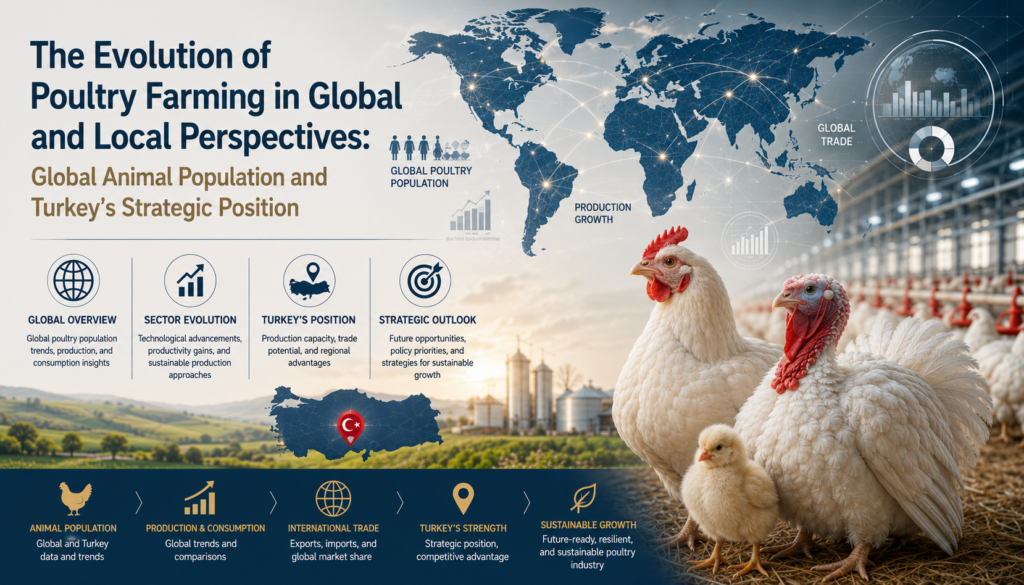
1. Historical Evolution: How Far Has the Poultry Industry Come?
The poultry sector has achieved a tremendous technological leap, transforming from backyard farming and extensive systems in the 1950s into modern, fully automated industrial facilities controlled by artificial intelligence today. The rational mechanism driving this leap rests upon a three-legged stool: Genetic Selection + Precision Nutrition + Climate Control (Automation).
To mathematically comprehend the scale of this evolution, one only needs to examine the historical performance data of broiler production:
- The 1950s: It took approximately 85–90 days for a broiler chicken to reach a market weight of 1.5 kg, with a Feed Conversion Ratio (FCR) stagnating around 3.0. This meant 3 kg of feed was required to produce 1 kg of meat.
- Modern Standards: Thanks to intensive genetic selection and advanced climate automation, a modern broiler can achieve a live weight of 2.5 kg} in just 33–35 days, with FCR values dropping into the 1.40 – 1.50 band.
This incredible efficiency advancement has turned the poultry sector into the livestock industry with the lowest carbon footprint and the most optimized resource utilization.
2. Global Poultry Dynamics: Livestock Inventory and Production Powerhouses by Country
Global poultry meat production is rapidly approaching the 140 million metric ton threshold annually. When examining global livestock inventories and production volumes, it is evident that the market is highly concentrated among a few global superpowers:
- United States (USA): The world’s largest producer of broiler meat. The US pioneered the vertical integration model globally and leverages its massive domestic corn and soybean raw material advantage with peak rationality. It accounts for roughly %15-17 of total global production.
- Brazil: The undisputed leader of global exports. Bolstered by immense logistical power in raw material (soybean and corn) agriculture and low-cost labor infrastructure, Brazil stands as the world’s most cost-efficient and high-quality chicken meat supplier, maintaining a dominant presence in Middle Eastern, Asian, and European markets.
- China: Possesses a massive livestock inventory alongside being the largest consumer market. While China leads numerically in both broiler and commercial layer inventories, the sheer volume of its domestic demand steers its focus toward internal markets rather than net exportation.
- European Union (EU): Led by Poland, the EU stands out for its stringent animal welfare standards and strict biosecurity protocols. However, rigid environmental legislation and high energy overheads restrict the expansion rate of its production capacity.
3. Turkey’s Position in Global Competition and Sectoral Outlook
Turkey commands one of the most advanced and modernized poultry production infrastructures worldwide. Having achieved a completely industrialized framework since the 1980s via the “Contract Farming Model” (Integration System), the Turkish poultry sector firmly maintains its place among the top 10 producing nations globally.
Structural Advantages and Strengths of Turkey:
- Logistical and Geographical Probability: Turkey occupies a prime crossroads between the Middle East, North Africa, the Gulf Countries, and Europe. This geographic positioning provides a massive time and freight advantage over distant competitors like Brazil and the USA, particularly in the logistics of fresh and frozen exports. Turkey remains one of the primary suppliers to Iraq, Iran, and the Gulf region.
- Technological Infrastructure: The vast majority of poultry houses in Turkey were built or fully modernized within the last 15–20 years. Negative pressure ventilation layouts, tunnel systems, and automated feeding/watering chains are operated at the highest tier of global standards (Aviagen/Cobb).
Sectoral Constraints and Risk Analysis:
- Import-Dependent Raw Material Loop: The Achilles’ heel of the Turkish poultry sector is its high dependency on imported feed ingredients, particularly soybeans, soybean meal, and certain micro-ingredients. Exchange rate fluctuations and global commodity market volatility inflict immediate, direct shifts on domestic production costs.
- Biosecurity and Epidemiological Pressure: Situated directly along the migratory pathways of wild birds, Turkey face persistent Avian Influenza exposure risks during seasonal transitions. This environmental constraint mandates the uncompromising enforcement of strict biosecurity protocols and closed-house automation setups.
Summary: The Future of Poultry Production and Digital Transformation
Poultry production has transitioned from rural backyards into an apex intersection where biology meets industrial engineering. Turkey remains a formidable player in this global arena due to its superior production quality, rapid logistical turnaround, and modern facility design. Future sectoral success will depend heavily on optimizing domestic raw material production, integrating energy-saving smart automation loops into facilities, and executing preventative veterinary medicine driven by data analytics.
References:
1. FAO (Food and Agriculture Organization) (2024). Global Poultry Production and Meat Market Review. FAO Animal Production and Health Statistics.

2. USDA (United States Department of Agriculture) (2025). Livestock and Poultry: World Markets and Trade. Foreign Agricultural Service Circular.

3. BESD-BİR (Turkish Poultry Meat Producers and Breeders Association) (2025). Turkish Poultry Sector Report and Statistics.

4. Havenstein, G. B., Ferket, P. R., & Qureshi, M. A. (2003). Growth, livability, and feed conversion of 1957 versus 2001 broilers when fed representative 1957 and 2001 broiler diets. Poultry Science, 82(10), 1500-1508.