
One of the most persistent misconceptions in public discourse regarding modern poultry production is the belief that commercial chickens grow unnaturally fast due to chemical intervention: “Decades ago, a chicken took six months to grow; today, they reach market weight in just 40–42 days. They must be using hormones or genetic modification!”
As a practicing Veterinary Surgeon working in poultry production, it is essential to address these concerns with transparency, scientific facts, and field realities. This article breaks down the science behind 42-day broiler growth, debunks the hormone myth, explains the field practice known as “thinning” (partial depopulation), and evaluates the safety of modern poultry meat for consumers.
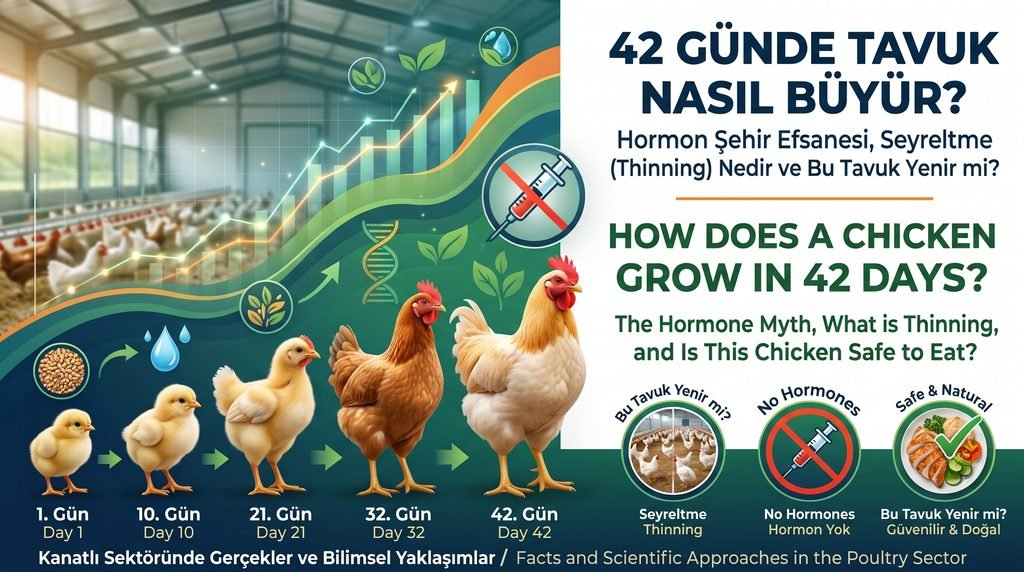
1. How Do Broilers Reach 2.5–3.0 kg in 42 Days? Is It Hormones?
The short answer: ABSOLUTELY NOT. Exogenous growth hormones are never used in poultry production.
The rapid growth of modern commercial broilers relies on three scientific pillars:
A. 70 Years of Traditional Selective Breeding (Natural Selection, Not Genetic Modification)
Since the 1950s, poultry geneticists have not altered the avian genome through direct gene editing (GMO). Instead, progress has been driven by conventional pedigree selection—mating the healthiest, fastest-growing birds with the best feed conversion efficiency generation after generation.
Over seven decades of selective breeding, the time required for a bird to naturally reach a market weight of 2.5 kg has been reduced from months to just 6 weeks.
B. Precision Nutrition
Commercial broilers do not receive random feed formulations. Diets are engineered by veterinary nutritionists down to precise amino acid, energy, mineral, and vitamin balances based on the exact age and physiological stage of the flock. Just as an athlete follows a tailored nutritional plan to build muscle efficiently, broilers receive optimized diets tailored for every stage of growth.
C. Automated Environmental Control (Precision Housing)
Wild or back-yard poultry expend significant metabolic energy coping with ambient heat, winter cold, rain, and wind. In modern commercial poultry houses, microclimate parameters—temperature, relative humidity, air velocity, and static pressure—are regulated 24/7 by automated climate computers. By eliminating environmental stress, the bird can convert dietary nutrients directly into healthy growth.
2. What Is “Thinning” (Partial Depopulation) and Why Is It Performed?
A standard management practice in broiler production that remains largely unknown to the general public is “Thinning” (also referred to as partial depopulation or interim harvesting).
How Does Thinning Work?
When day-old chicks arrive at the poultry house, they occupy a small fraction of the floor area. As they grow, total biomass per square meter (stocking density) increases significantly.
- Interim Harvest (Days 32–35): Once the flock reaches a specific density threshold, approximately 20% – 25% of the house population (typically females or birds that have reached target light-broiler weights) is harvested and transported to the processing plant.
- Environmental Relief for Remaining Birds: Thinning immediately drops the stocking density inside the house. Feeder space, drinker access, and airflow around the remaining birds (typically males) increase dramatically.
- Final Harvest (Days 40–42): The remaining flock continues to grow with reduced competition and lower heat load until reaching full target weight (2.8 – 3.2 kg), at which point the house is completely cleared.
Thinning is a welfare-centric management tool designed to optimize house air quality, prevent overcrowding, and maintain litter conditions.
3. Why the “Hormone Myth” Is Logistically and Biologically Impossible
From both a veterinary pharmacological and operational perspective, administering growth hormones to commercial poultry is impossible for two primary reasons:
- Operational & Economic Infeasibility: A single commercial house typically holds 30,000 to 50,000 birds. Hormones would have to be injected individually into every single bird on a daily basis. The labor required—and the severe handling stress inflicted on the birds—would make this practice cost-prohibitive and lethal to the flock.
- Biological Inactivation: Hormones are protein-based molecules. If added to feed or drinking water, they would be broken down instantly by stomach acids and proteolytic enzymes in the avian digestive tract, rendering them inactive.
- Lack of Biological Need: Modern broiler genetics are already optimized to achieve their growth potential through balanced nutrition and proper brooding environment.
4. Is 42-Day Broiler Meat Safe for Consumption?
YES, IT IS ENTIRELY SAFE.
Modern broilers are raised under strict biosecurity protocols to protect them from external disease vectors (such as Avian Influenza). Their health, feed quality, and water sanitation are monitored continuously by licensed veterinarians.
- What About Antibiotic Residues? When a flock requires veterinary treatment for a diagnosed disease, medications are administered under strict veterinary prescription. By law, mandatory withdrawal periods must be observed before any flock can be sent to the processing facility, ensuring that meat products entering the food chain are completely free of antibiotic residues.
Summary
The ability of modern poultry to reach market weight in 42 days is the direct result of advancements in quantitative genetics, precision nutrition, veterinary care, and environmental engineering. The use of growth hormones is a complete myth. Consumers can confidently purchase and consume inspected, packaged broiler meat knowing it meets strict safety and quality standards.